NASA Curiosity rover discovers honeycomb field on Mars
NASA's Curiosity rover discovered a vast field of honeycomb-shaped polygonal fractures in 'Valle Grande', Gale Crater, on Mars. Images taken June 19-20, 2026 (Sol 4930-4931) show polygons 4-8 cm wide, a concentration never seen before at this scale. Scientists say the find 'took our breath away.' Separately, a cracked wheel with 14+ broken grousers is being monitored (Sol 4963, Jul 23). Sources: NASA JPL, CTV News, The Register.
The context
NASA Curiosity Rover Finds a Honeycomb Field on Mars
A routine panoramic sweep in a Martian valley has produced one of the most visually striking discoveries in the Curiosity rover’s nearly 14-year history. In late July 2026, NASA’s Jet Propulsion Laboratory published images taken on June 19-20, 2026 (Sol 4930-4931 of the mission) showing a vast field of polygonal fractures covering the surface of the valley floor in a pattern that closely resembles a giant honeycomb. Each polygon measures roughly 4 to 8 centimetres across, and the sheer density of the features stretching across the landscape was unlike anything Curiosity had photographed before. Scientists described it as having “taken our breath away.”
The site is a valley nicknamed “Valle Grande” inside Gale Crater, where the rover has been exploring since its 2012 landing. Scientists investigating the fractures have put forward three main hypotheses for their formation: ancient dried mud cracks from a lake bed that evaporated over geological time; thermal contraction and expansion cycles from the extreme Martian temperature swings cracking the rock into geometric shapes; or pressure-driven changes in deep sediment layers. The polygonal geometry is consistent with all three, and narrowing down the answer will require detailed geochemical analysis.
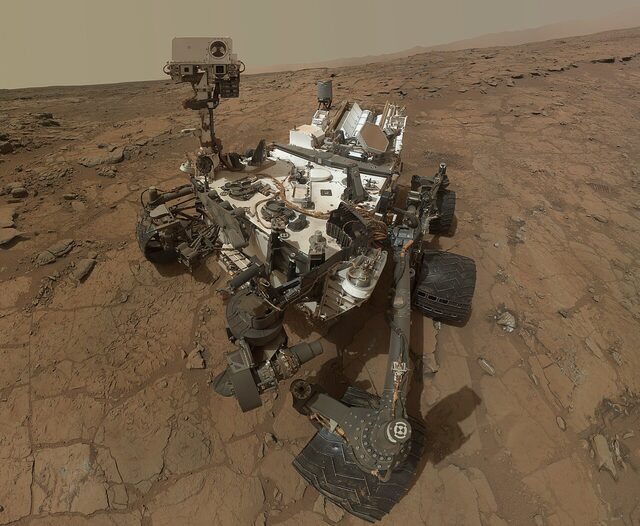
The discovery comes as the rover also faces a hardware challenge: a cracked rear wheel photographed on Sol 4963 (July 23, 2026) showed more than 14 broken grousers, the metal cleats designed to grip the Martian terrain. After 32+ kilometres of driving over 14 years, Curiosity’s wheels have accumulated significant wear. NASA JPL engineers are preparing contingency plans, including a technique called “rock-snap” to manage the degradation, but the rover remains operational and continues to send scientific data. Sources: NASA JPL, CTV News, The Register, Space.com, TechTimes.