Formula 1 2026 Season
Kimi Antonelli (Mercedes) leads the 2026 F1 championship on 340 points after 17 of 23 rounds, 102 clear of teammate George Russell (238), with Lewis Hamilton third on 229 and Max Verstappen fourth on 221 after back-to-back wins at the Bahrain Grand Prix held at Sepang (October 4) and the Singapore Grand Prix (October 11). Mercedes lead the constructors on 578 from Ferrari (444), McLaren (339) and Red Bull (332). Six rounds remain, worth up to 150 points, starting with the United States Grand Prix in Austin on October 23-25, where Antonelli can clinch the title. Sources: formula1.com, Sky Sports, RaceFans, GPFans.
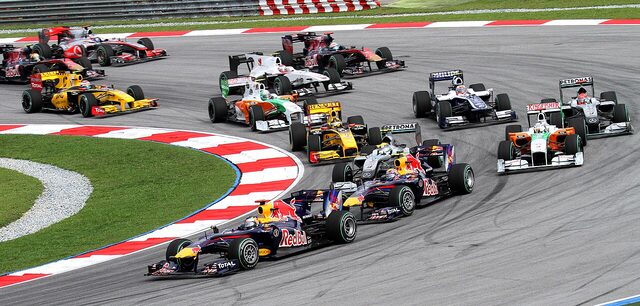
The context
The 2026 Formula 1 season marks the sport’s most significant reset in years. New technical regulations reshape almost everything: the cars are shorter, lighter and more agile, the power units draw roughly half their energy from electricity and run on Advanced Sustainable Fuels, and the familiar DRS gives way to Overtake Mode, a deployable burst of electric power for a car within a second of the one ahead.
Aerodynamics change too. Active aero lets the wings shift between a high-downforce Corner Mode and a low-drag Straight Mode, replacing the fixed-wing approach and, together with Overtake Mode, aiming for closer racing. Big rule resets tend to shuffle the pecking order, so the early season was really a race to understand the new formula fastest. Mercedes understood it first, and the standings have reflected that ever since.
Off the grid design, the story is expansion. Audi enters as a works team after absorbing Sauber, running its own power unit with Nico Hulkenberg and Gabriel Bortoleto. Cadillac becomes the first eleventh team since 2016, powered by Ferrari, with veterans Valtteri Bottas and Sergio Perez. Two new manufacturers plus a clean-sheet rulebook make 2026 one of the most unpredictable F1 seasons in memory, on paper at least.
Standings after 17 of 23 rounds. Kimi Antonelli leads on 340 points, 102 clear of Mercedes teammate George Russell (238) and 111 clear of Lewis Hamilton (229). Max Verstappen is fourth on 221 after two straight wins, Charles Leclerc fifth on 215 and Lando Norris sixth on 201. Mercedes lead the Constructors’ Championship on 578 points, ahead of Ferrari (444), McLaren (339) and Red Bull (332). Sources: formula1.com, Sky Sports.
The recent run. Norris won at Zandvoort on August 23 while Verstappen crashed out on the opening lap of his home race. Antonelli then took Monza on September 6 from 19th on the grid, with Russell second, and followed it with victory at the new Madring circuit in Madrid on September 13, ahead of Verstappen and Norris. Baku bit back: Antonelli crashed in qualifying, and Russell won the Azerbaijan Grand Prix on September 26 from pole while Antonelli salvaged fifth. Then Verstappen came alive. He won the rain-hit Bahrain Grand Prix at Sepang on October 4, ahead of Antonelli and Hamilton, as Russell retired late with an engine failure, and swept the Singapore weekend on October 11 with pole, the sprint and the grand prix, his first win there, Leclerc second and Antonelli third. Russell, starting from the back after a power unit penalty, finished ninth. Across those two rounds Antonelli scored 38 points to Russell’s 2, and the gap went from 66 to 102.
What is left. Six rounds and no more sprints: the United States (October 23-25), Mexico (October 30 to November 1), Brazil (November 6-8), Las Vegas (November 19-21), Qatar (November 27-29) and Abu Dhabi (December 4-6). At most 150 points remain on the table. According to Sky Sports, Antonelli is champion in Austin if he outscores Russell by 23 points and Hamilton by 14. Sources: formula1.com, Sky Sports, RaceFans.
People also ask
True or false?
There are two Spanish rounds in 2026: Barcelona-Catalunya in June and the new Madring circuit in Madrid in September. Plenty of results tables have confused the two. (formula1.com)
He started 19th at the Italian Grand Prix on September 6 and won it, with Russell second. Seventh win of his season. (PlanetF1, The Race)
It kept the Bahrain name but ran at Sepang in Malaysia, after the April race was cancelled because of the 2026 Iran war. Verstappen won it. (formula1.com, Wikipedia)
They are hybrids, roughly half electric and half combustion, with the engine running on 100% sustainable fuel. Loud, not silent. (formula1.com)
The Dutch Grand Prix leaves the calendar after 2026, and the August race was also the circuit's first Sprint weekend. (formula1.com, dutchgp.com)
The eleventh team debuts with Ferrari power units rather than an engine of its own. (formula1.com)
His first win of the season came at the Bahrain Grand Prix at Sepang on October 4, round 16, followed by Singapore on October 11. (GPFans, formula1.com)
With a 102-point lead and 150 points left, he is champion in Austin if he outscores Russell by 23 points and Hamilton by 14. (Sky Sports; calculation by stats-data)