datastats / SIGNAL
enfresde
LIVE
← ALL SIGNALS
datastats / News
News ▲ Rising Trend score 84 · Published September 19, 2026 · Updated September 19, 2026

Daylight Saving Time 2026: When the Clocks Go Back

The clocks go back on two different dates in 2026. The European Union and the United Kingdom change on Sunday, October 25, and the United States and Canada follow a week later on Sunday, November 1, so for that week the gap between London and New York is four hours instead of five. Both sides are debating whether to stop: the US House passed the Sunshine Protection Act 308 to 117 on July 14, 2026 and the bill is sitting in a Senate committee, while the EU's 2018 proposal has been stuck in the Council for seven years. Sources: timeanddate, Congress.gov, European Commission, Council of the EU.
By · datastats
INTEREST INDEX
84 +12% · 24h
Daylight Saving Time 2026: When the Clocks Go Back
TimeZonesBoy · CC BY-SA 3.0
30-DAY PEAK
89
modeled window
90-DAY AVG
57
trending up
TREND SCORE
84
+12% · 24h
TRACKED QUESTIONS
14
from public queries
INTEREST OVER TIME
Momentum trajectory
PEAK 89
30d ago15dtoday

The context

The clocks go back twice in 2026, on two different dates, and the gap between them is the part that catches people out. Europe and the United Kingdom change on Sunday, October 25. The United States and Canada change a week later, on Sunday, November 1. Both move back one hour. Both give you the extra hour of sleep. Neither does it on the same weekend, and for the seven days in between, the usual time difference between Europe and North America is an hour smaller than normal: London to New York is four hours rather than five, Paris to New York is five rather than six.

The split is legislative, not astronomical. The EU pinned its change to the last Sunday in October. The United States moved its own to the first Sunday in November with the Energy Policy Act of 2005, which took effect in 2007. Nobody harmonised the two, so the mismatch recurs every year in both directions, one week in autumn and two in spring. The next spring change is March 14, 2027 in the United States and March 28, 2027 in Europe.

What makes 2026 different is that both sides are actively trying to stop. In the United States, the House passed the Sunshine Protection Act on July 14, 2026 by 308 votes to 117, a margin wide enough to cross party lines comfortably. The bill would make daylight saving time permanent nationwide, keeping the country on the later-evening time all year, with an opt-out for states that would rather stay on standard time. It reached the Senate on July 15 and was referred to the Commerce, Science and Transportation Committee, where it has not moved. President Trump has publicly supported it, on the grounds that the twice-yearly switch costs households, cities and states money for nothing in return. Nothing changes until the Senate votes and the bill is signed, so the November 1 change still happens.

Europe has been at this longer and got less far. The Commission proposed ending seasonal clock changes in 2018, the Parliament voted for it in March 2019 with a 2021 target, and the Council has never agreed a position. The blocking problem was never the principle but the choice: permanent summer time or permanent winter time, and how to stop neighbouring countries picking differently and fracturing the single market into a patchwork of time zones. Covid and the war in Ukraine pushed it off the agenda entirely. The Commission has since flagged the file for withdrawal in its Omnibus simplification package, while stating in March 2026 that ending the changes remains possible and that a supporting study will be published by the end of 2026.

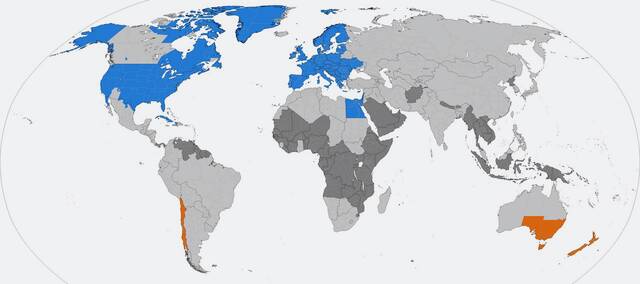
Worth remembering how recent and how narrow the practice is. It was introduced as a wartime fuel-saving measure, first by Germany and Austria-Hungary in April 1916, and the energy case for it has been contested almost ever since. Most of the world does not bother: Japan, China, India, Russia, Turkey and nearly all of Africa, South Asia and the Middle East leave their clocks alone, and countries close to the equator have little to gain because day length barely moves. Within the United States, Hawaii and most of Arizona already opted out. Sources: timeanddate, Forbes, Congress.gov, The Hill, NBC News, Council of the EU, European Parliament.

People also ask

14 questions · sorted by search share

On two different Sundays, depending on where you are. Europe and the United Kingdom: Sunday, October 25, 2026. The United States and Canada: Sunday, November 1, 2026. Both move the clock back one hour, so both gain an hour of sleep, just a week apart. Sources: timeanddate, Forbes.

Sunday, November 1, 2026 at 2:00 a.m. local time, when clocks go back to 1:00 a.m. The rule has been the first Sunday in November since the 2005 Energy Policy Act took effect in 2007. It applies in every state except Hawaii and most of Arizona, which never move. Source: timeanddate.

Sunday, October 25, 2026 at 2:00 a.m. BST, when the clocks go back to 1:00 a.m. and the UK returns to Greenwich Mean Time for the winter. British Summer Time resumes on the last Sunday of March 2027, which is March 28, 2027. Sources: timeanddate, Forbes.

Sunday, October 25, 2026, on the same instant across the EU, which lands at a different wall-clock time in each zone. Western European Time, including the UK, Ireland and Portugal: 2:00 goes back to 1:00. Central European Time, including France, Germany, Spain, Italy and Poland: 3:00 goes back to 2:00. Eastern European Time, including Greece, Finland and Romania: 4:00 goes back to 3:00. Sources: timeanddate, Forbes.

Because they legislated separately and never lined the dates up. The EU fixed its change to the last Sunday in October; the United States moved its own to the first Sunday in November with the 2005 Energy Policy Act, effective 2007. In most years that leaves a one-week window where the usual time difference between the two continents is an hour smaller than normal. In 2026 that window is October 25 to November 1.

You gain one. The autumn change repeats an hour, so the night is 25 hours long and you get an hour more sleep. The cost is the evenings: sunset jumps an hour earlier the same day, which is the part people actually notice. The reverse happens in spring, when an hour disappears.

It is closer than it has been, but it is not law. The House passed the Sunshine Protection Act (H.R. 139) on July 14, 2026 by 308 votes to 117, a wide bipartisan margin. The bill went to the Senate on July 15 and was referred to the Commerce, Science and Transportation Committee, where it currently sits. President Trump has backed it, arguing the twice-yearly switch costs households, cities and states money for no return. Until the Senate acts and it is signed, the clocks keep changing. Sources: Congress.gov, The Hill, NBC News.

It would make daylight saving time permanent nationwide, locking the country onto the time it currently keeps from March to November rather than onto standard winter time. States that wanted to stay on permanent standard time would have to exempt themselves before it took effect. The practical result would be later sunrises in midwinter and no more clock changes in either direction. Source: Congress.gov.

Not in 2026, and possibly not at all in its current form. The Commission proposed ending seasonal changes in 2018 and the European Parliament voted for it in March 2019, but the Council never agreed a position, because member states could not settle on whether to keep permanent summer or permanent winter time and how to avoid a patchwork of time zones across neighbouring countries. The Commission has since signalled it will withdraw the proposal as part of its Omnibus simplification package, while saying in March 2026 that ending the changes is still possible and that it will publish a supporting study by the end of 2026. Sources: Council of the EU, European Parliament, European Commission.

Hawaii and most of Arizona, where the Navajo Nation is the exception and does observe it. Among the territories, Puerto Rico, the US Virgin Islands, Guam, American Samoa and the Northern Mariana Islands stay on standard time all year. Everywhere else in the United States changes twice a year. Source: timeanddate.

The United States: Sunday, March 14, 2027, the second Sunday in March. The EU and the UK: Sunday, March 28, 2027, the last Sunday in March. That is a two-week gap in spring, longer than the one-week gap in autumn, because the two rules are anchored differently at each end.

Yes, for one week. Normally London is five hours ahead of New York. Between October 25 and November 1, 2026 the UK has already gone back to GMT while the US East Coast is still on daylight time, so the gap narrows to four hours. It returns to five on November 1. The same one-hour squeeze applies between Paris, Berlin or Madrid and the US East Coast.

To save fuel in wartime. Germany and Austria-Hungary adopted it first, in April 1916, to cut coal use for lighting, and Britain and much of Europe followed within weeks. The United States adopted it in 1918, repealed it, then reinstated it in the Second World War and again with the 1966 Uniform Time Act. The energy argument that justified it has been disputed for decades, which is most of why the policy keeps coming back up.

Most of the world, in fact. Japan, China, India, Russia, Turkey and almost all of Africa, South and Southeast Asia and the Middle East do not change their clocks. Countries near the equator gain almost nothing from it, because day length barely varies. Where it is used, it is concentrated in Europe, North America, and parts of the southern hemisphere such as Chile, Paraguay, New Zealand and southeastern Australia, which change in the opposite months.

INTEREST BY REGION
Where it's trending
United States
100
India
65
United Kingdom
56
France
34
Germany
32
Canada
26
Japan
21
Brazil
19
Sources
Public-source data, structured and editorially reviewed.