Oktoberfest 2026: Dates, Beer Prices and How It Works
The 191st Oktoberfest runs September 19 to October 4, 2026, sixteen days on Munich's Theresienwiese. Mayor Dominik Krause taps the first barrel at noon in the Schottenhamel tent, his first time doing it. A litre of beer costs 14.80 to 15.90 euros, averaging 15.61. Entry to the grounds and the tents is free, the historic Oide Wiesn costs 4 euros and switches to QR codes in 2026. Around 6 million visitors are expected. Sources: muenchen.de, City of Munich.
The context
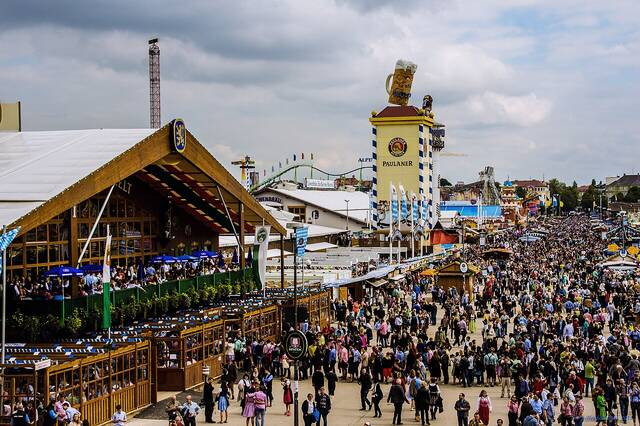
Oktoberfest 2026 is the 191st Wiesn, running from Saturday, September 19 to Sunday, October 4, the usual sixteen days on Munich’s Theresienwiese. The festival is only ever extended when German Unity Day on October 3 lands on a Monday or Tuesday. In 2026 it falls on a Saturday, so this is a standard-length year.
The start is fixed and ceremonial: noon on the opening Saturday in the Schottenhamel tent, and this time with a new face. Mayor Dominik Krause takes his first turn at the tapping, and the number of hammer blows he needs to open the first barrel is the one statistic the whole city will discuss that afternoon. Nothing is poured anywhere on the grounds until he calls out “O’zapft is!”.
Prices keep climbing, though more gently than feared. A Maß, the one-litre stein, costs 14.80 to 15.90 euros, averaging 15.61. The cheapest remains the Augustiner-Festhalle at 14.90, while several of the large tents sit at 15.90, which means the 16 euro barrier survives another year. Non-drinkers do not get off lightly: mineral water is 11.13 euros a litre, lemonade 12.47 and Spezi 12.84. Alcohol-free beer, at roughly 15.73 euros, costs almost exactly what the real thing does.
The practical answers change least and get asked most. There is no entry fee, not for the grounds and not for the tents, and no general admission ticket exists. You do not have to reserve: every tent keeps a set share of seats for walk-in guests, though the big ones frequently close their doors by early afternoon on weekends because they are simply full. If you want space to breathe, go on a weekday morning. Only the six Munich breweries, Augustiner, Hacker-Pschorr, Hofbräu, Löwenbräu, Paulaner and Spaten, are allowed to serve, across 14 large tents and 21 smaller ones.
The clearest change for 2026 concerns the Oide Wiesn, the historic section in the south of the grounds with vintage rides, brass bands and quieter tents. Entry stays at 4 euros and remains free after 9 p.m., but access now runs on QR codes rather than wristbands, with a stamp for re-entry and an extra gate closer to the main festival. Across the sixteen days, around 6 million visitors are expected. Sources: muenchen.de, City of Munich, oktoberfest.de.
Eight days out, the practical questions are the ones that decide whether a day on the Wiesn works. Bags are capped at three litres, roughly 20 by 15 by 10 centimetres, which rules out an ordinary backpack; metal detectors have been standing at the entrances since 2024. A total knife ban applies across the grounds, including the traditional Trachtenmesser tucked into Lederhosen, and cannabis stays prohibited despite partial legalisation, with reported fines running to 1,000 and 1,500 euros respectively.
Getting there is a U-Bahn question. Theresienwiese on the U4 and U5 is the obvious stop and also the one most often closed for crowd control, so Goetheplatz, Poccistrasse and Schwanthalerhoehe are the useful fallbacks, and the Hauptbahnhof is a ten-minute walk. On price, the single cheapest Maß in 2026 is in the Museumszelt at 14.80 euros, the Augustiner-Festhalle is cheapest among the fourteen big tents at 14.90, and the overall rise on 2025 comes to about 2.38 percent. Sources: muenchen.de, Abendzeitung, iamexpat.
People also ask
True or false?
It starts on September 19 and ends on October 4. Only the closing Sunday falls in October, the name dates back to the founding festival of 1810. (muenchen.de)
The most expensive tent charges 15.90 euros, with a 15.61 average. The 16 euro line holds for one more year. (muenchen.de)
Every tent keeps a fixed share of seats for walk-ins. Come early, ideally on a weekday morning, and you will get in. (muenchen.de)
Grounds and tents cost nothing, there is no general ticket. Only the Oide Wiesn charges 4 euros, and it is free there after 9 p.m. (muenchen.de)
Only the six Munich breweries: Augustiner, Hacker-Pschorr, Hofbräu, Löwenbräu, Paulaner and Spaten. (muenchen.de)
Access moves to QR codes, with a stamp for re-entry and an additional entrance. (muenchen.de)
Bags are capped at three litres, or 20 by 15 by 10 centimetres. Anything bigger is refused at the gate. (Abendzeitung, oktoberfest.de)