datastats / SIGNAL
enfresde
LIVE
← ALL SIGNALS
datastats / News
LIVE
News ▲ Rising Trend score 82 · Published August 21, 2026 · Updated August 21, 2026

Blood Moon August 2026: Lunar Eclipse Aug 27-28

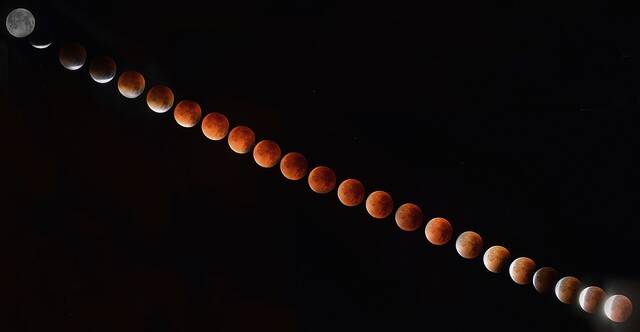
A deep partial lunar eclipse, 96.2% of the Moon in Earth's shadow, will occur on the night of August 27-28, 2026. The partial phase runs 02:33–05:52 UTC, with maximum at 04:12 UTC (12:12 a.m. EDT / 9:12 p.m. PDT on Aug 27). Visible across the Americas, Europe (near moonset), and Africa. No special equipment needed, safe to view with the naked eye. The Moon will appear dark red or copper near maximum. Sources: EarthSky, Space.com, BBC Sky at Night, timeanddate.com.
By · datastats
INTEREST INDEX
82 +12% · 24h
30-DAY PEAK
85
modeled window
90-DAY AVG
55
trending up
TREND SCORE
82
+12% · 24h
TRACKED QUESTIONS
9
from public queries
INTEREST OVER TIME
Momentum trajectory
PEAK 85
30d ago15dtoday

The context

A rare near-total lunar eclipse will sweep across the night sky on August 27–28, 2026, when 96.2% of the Moon slips into Earth’s darkest shadow. The event is one of the most dramatic lunar phenomena in years: while it falls just short of a complete blood moon (a true total eclipse), the visible difference is minimal, virtually the entire disc will glow a deep red or copper color at maximum, making for a stunning naked-eye spectacle.

The partial eclipse phase runs from 2:33 to 5:52 UTC on August 28, with maximum coverage at 4:12 UTC (12:12 a.m. EDT / 9:12 p.m. PDT on the evening of August 27). Including the fainter penumbral phase, the event lasts a total of 5 hours 38 minutes. No equipment is required to enjoy it, though binoculars or a small telescope will show the coloring in dramatic detail.

Who sees it best: The Americas win this eclipse. The entire contiguous United States, eastern two-thirds of Canada, and all of South America have the Moon well placed in the sky throughout the partial phase. Western Europe (France, Spain, Germany, UK) can observe the opening and much of the peak, but the Moon sets near dawn, observers there should find high western ground and clear skies. India and most of Asia miss out entirely. This is the last deep partial lunar eclipse visible until January 2028, so for those in the coverage zone, it is one not to skip. Sources: EarthSky, Space.com, BBC Sky at Night, timeanddate.com.

The Moon had already made headlines a fortnight earlier, as Solar Eclipse August 12 2026 - France, Spain, Europe recounts from the cities that fell into complete darkness.

People also ask

9 questions · sorted by search share

The deep partial lunar eclipse, often called a blood moon, takes place on the night of Thursday August 27 into Friday August 28, 2026. The partial eclipse begins at 2:33 UTC and reaches its maximum at 4:12 UTC on August 28 (= 12:12 a.m. EDT / 9:12 p.m. PDT on August 27). The partial phase lasts 3 hours 18 minutes, ending at 5:52 UTC. Sources: EarthSky, timeanddate.com.

Not technically. It is a deep partial lunar eclipse, 96.2% of the Moon enters Earth's dark umbral shadow, but a tiny bright sliver (about 4%) will remain outside the shadow. A true blood moon requires 100% totality. However, at peak the Moon will appear distinctly dark red or copper-colored across most of its surface, so it is commonly, and fairly, called a blood moon. Sources: EarthSky, Space.com, BBC Sky at Night.

The eclipse is visible from most of the Americas (the best view, the entire continental US, eastern two-thirds of Canada, and all of South America), Europe (Moon near the western horizon at moonset), Africa, and parts of Antarctica and the eastern Pacific Ocean. It is not visible from India, most of Asia, or Australia. In Western Europe (France, Spain, Germany, UK) the eclipse begins before dawn but the Moon will be low in the west and setting by the time the partial phase ends. Sources: EarthSky, starwalk.space.

All times are on the night of August 27 into August 28, 2026: - Partial eclipse begins: 10:33 p.m. EDT / 9:33 p.m. CDT / 8:33 p.m. MDT / 7:33 p.m. PDT (August 27) - Greatest eclipse (maximum): 12:12 a.m. EDT / 11:12 p.m. CDT / 10:12 p.m. MDT / 9:12 p.m. PDT (Aug 27/28 depending on time zone) - Partial eclipse ends: 1:52 a.m. EDT / 12:52 a.m. CDT / 11:52 p.m. MDT / 10:52 p.m. PDT All of the contiguous US can see the entire partial phase. Sources: EarthSky, The Hill, timeanddate.com.

No. Lunar eclipses are completely safe to view with the naked eye, no special glasses needed, unlike solar eclipses. The Moon only reflects sunlight and is in Earth's shadow; there is no risk to your eyes. Binoculars or a telescope will give a much more dramatic view of the coloring, but you don't need any equipment at all. Sources: EarthSky, Space.com.

During a partial or total lunar eclipse, Earth blocks direct sunlight from reaching the Moon. However, Earth's atmosphere bends (refracts) sunlight around the planet, and this refracted light is shifted toward red wavelengths, the same effect that makes sunrises and sunsets appear red. The red-tinted light reaches the eclipsed part of the Moon, giving it a copper or rust color. The deeper the Moon goes into Earth's shadow, the more vivid the red glow. Sources: EarthSky, Space.com.

In UTC+2 (France, Germany, central Europe in summer): partial eclipse begins at 4:33 CEST, greatest eclipse at 6:12 CEST on August 28. Sunrise in France is around 7:00 CEST, so the Moon will be low in the western sky and setting as the eclipse peaks. It is visible but challenging. In the UK (BST = UTC+1): partial phase starts 3:33 a.m., peaks 5:12 a.m., the Moon will be west, low, and will set before the partial phase ends. Best views from high ground facing west, or the west coast of Ireland. Sources: BBC Sky at Night, EarthSky.

At 96.2%, this is the deepest partial lunar eclipse since September 2024, and the last deep partial or total lunar eclipse until January 2028. It closes a rare 18-month sequence of lunar eclipses. While it falls short of being a full blood moon (which requires 100% totality), 96.2% coverage is effectively indistinguishable to the naked eye from a total eclipse at the edges; only a thin bright rim remains visible. Sources: TechTimes, Space.com, EarthSky.

For smartphone photography: use a tripod or steady surface, tap on the Moon on your screen to set focus, enable Night or Pro mode if available, and manually lower the exposure to avoid a washed-out image. For DSLR or mirrorless cameras: use a telephoto lens (300mm+), manual settings (ISO 400–800, aperture f/8, shutter 1/15–1/60 at maximum eclipse), and a remote shutter or timer to avoid camera shake. The best shots will come around maximum eclipse (4:12 UTC) when the Moon's coloring is deepest. Sources: Space.com, Sky & Telescope.

INTEREST BY REGION
Where it's trending
India
100
United Kingdom
74
United States
63
Germany
63
France
57
Brazil
35
Mexico
14
Spain
14
Sources
Public-source data, structured and editorially reviewed.