datastats / SIGNAL
enfresde
LIVE
← BRANDS
datastats / Money
LIVE
Money

Mercadona - People also ask

Mercadona is Spain's largest supermarket chain, family-owned, run by Juan Roig, with 1,676 stores and a 28.5 percent market share. It turned over 41.858 billion euros in 2025 and is now spending 3.7 billion to rebuild every store into a new format called Tienda 9.
By · datastats · Updated August 28, 2026
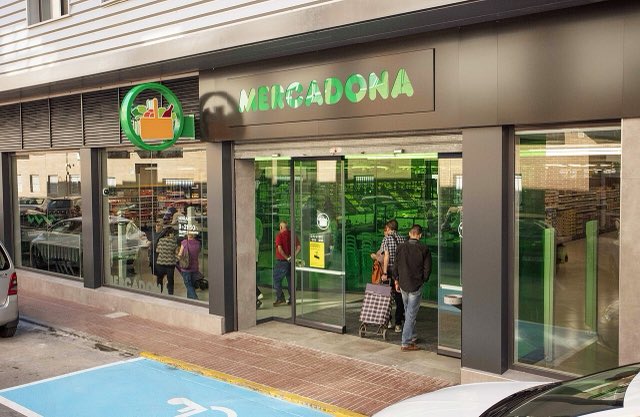
Mercadona
Carloss · CC BY-SA 4.0

Mercadona is the supermarket that Spain argues about. It sells roughly 28.5 percent of the country’s groceries, it has never taken outside money, and it is still run from Tavernes Blanques, a town of 9,000 people on the edge of Valencia, by the man who bought it from his parents in 1981.

Juan Roig owns half of it, his wife Hortensia Herrero thirty percent, and there is no share to trade. The commercial model is unusually simple and unusually rigid: permanent low prices instead of promotions, no loyalty card, and shelves dominated by own labels, Hacendado for food, Deliplus for cosmetics, Bosque Verde for cleaning, Compy for pets. Those products come from interproveedores, manufacturers locked into long-term exclusive contracts, which is how Mercadona controls both cost and recipe without owning factories.

The numbers from 2025, published in March 2026, were the best in its history: 41.858 billion euros in revenue, up 8 percent, and 1.729 billion in net profit, up 25 percent, across 1,676 stores and 115,000 employees. Which is exactly when Roig announced he was going to pull the whole thing apart. Tienda 9 is a 3.7 billion euro plan to rebuild every store around processes rather than departments, with a central workshop handling all preparation and far more space given to fresh food and ready meals. Fifty-nine stores convert in 2026; the target for the full network is 2033.

Outside Iberia, none of this is visible. Mercadona trades in Spain and, since 2019, Portugal, and has never announced plans for a third market. Its one durable public controversy is a facial-recognition trial in 48 stores that ended with a 2.5 million euro fine from the Spanish data-protection regulator. Sources: Mercadona, Wikipedia, Forbes España, Merca2, FACUA, eldiario.es.

People also ask

It is privately held by the Roig family and has never been listed on a stock exchange. Juan Roig holds 50 percent and is chairman and chief executive; his wife Hortensia Herrero holds 30 percent, his brother Fernando Roig (also president of Villarreal CF) 9 percent, and the family of Rafael Gómez Gómez 7 percent. There is no Mercadona share to buy. Source: Wikipedia.

It is Spanish, founded in 1977 in Tavernes Blanques, a town just outside Valencia, where the head office still is. Francisco Roig Ballester and Trinidad Alfonso Mocholí started it as a small chain of butcher's shops inside the family's meat business. Their son Juan Roig bought it out in 1981 and turned it into a supermarket group. Source: Wikipedia.

1,676 supermarkets as of January 2026: 1,637 in Spain and 39 in Portugal. The Spanish network covers all 52 provinces plus Ceuta and Melilla, which makes Mercadona one of the very few retailers with genuine nationwide coverage. Portugal, entered in 2019, is the only foreign market. Source: Wikipedia.

Hacendado is Mercadona's own-label food brand, and the reason many shoppers go there at all. It sits alongside Deliplus for cosmetics and personal care, Bosque Verde for cleaning products and Compy for pet food. These labels are not made by Mercadona itself but by dedicated partners the company calls *interproveedores*, specialist manufacturers tied to Mercadona by long-term contracts. That structure is what lets it keep prices low and control recipes tightly.

It is built on a permanent low-price strategy rather than promotions: no loyalty card, no weekly discount leaflet, few multibuy offers, and a heavy tilt toward own-label products. Spanish consumer-group price surveys usually put Mercadona among the cheapest full-range chains, though hard discounters can beat it on specific baskets. The trade-off is choice: shelves carry fewer competing brands than at a Carrefour or an Alcampo.

In 2025 it turned over 41.858 billion euros, up 8 percent, of which 39.766 billion came from Spain and 2.092 billion from Portugal. Net profit was 1.729 billion euros, up 25 percent, a 4.5 percent margin on net sales and the highest in the company's history. It sold 15.067 billion kilo-litres of product, 4 percent more than the year before. Sources: Mercadona, Segre, Catalunya Econòmica.

28.5 percent of Spanish grocery distribution as of the 2025 results, up 0.6 percentage points in a year. That is roughly double its nearest competitor and the reason every price move it makes gets covered as national news. Sources: Mercadona, Forbes España.

It is Mercadona's new store format, announced in March 2026 with a 3.7 billion euro investment. The idea is to organise a shop by *processes* rather than by departments: a central workshop where all cutting, cooking and packing happens, more floor space for fresh produce and ready meals, and a faster route through the store. 59 supermarkets are being converted during 2026, and the goal is for the whole estate to be Tienda 9 by 2033. Converted stores close for roughly two weeks to a month during the works. Sources: Forbes España, Merca2, Revista Mercados.

115,000, after adding 5,000 jobs in 2025 (4,500 in Spain, 500 in Portugal). All staff are on permanent contracts, a policy the company has kept for decades, and it publishes an annual profit-share bonus. Wages above the sector norm and low turnover are a large part of how it defends the model. Sources: Mercadona, Bloomberg.

Yes, in Spain and Portugal, through its own site and app. Orders are picked in dedicated warehouses the company calls colmenas (hives) rather than in the shops themselves, which is why online coverage is city by city rather than nationwide. Mercadona was late to online grocery and rebuilt the whole operation from scratch in 2018 rather than bolting it onto stores.

Probably not soon. Outside Spain, Mercadona operates only in Portugal, where it entered in 2019 and has since invested more than a billion euros, including a 120,000 square metre logistics centre in Almeirim opened in June 2025. The company has never announced an entry into France, Italy or anywhere else, and its supplier model is tightly bound to the Iberian peninsula. Source: Wikipedia.

The best-documented case is a facial-recognition trial. Mercadona tested a biometric system in 48 stores to flag people under court restraining orders; Spain's data-protection authority, the AEPD, ruled it disproportionate and the company paid a 2.5 million euro fine after the complaint was brought by the consumer group FACUA. The regulator's core objection was that Mercadona had confused usefulness with necessity, and that shoppers had no realistic way to opt out. Sources: FACUA, eldiario.es, Xataka.

Related topics
Money Trending now
Richest people in the world 2026
Money Trending now
How to cancel Amazon Prime
Money Trending now
Coinbase vs Binance
Money Trending now
How to cancel Adobe Creative Cloud
Money Trending now
Compound interest
Money People
Bernard Arnault
Money People
Mark Cuban
Money People
Mukesh Ambani