← ALL SIGNALS
datastats / News
LIVE
News ● Peak Trend score 92 · Published June 23, 2026 · Updated June 23, 2026

Keir Starmer resigns as UK Labour leader

UK Prime Minister Keir Starmer announced on June 22, 2026 that he will resign as Labour leader, saying he is not 'best placed' to lead the party into the next general election. He remains PM until a successor is chosen. Nominations open July 9, close July 16, with a new leader expected before Parliament returns in September. Andy Burnham, who returned to Parliament via the Makerfield by-election on June 18, is the frontrunner, backed by Health Secretary Wes Streeting. Burnham would be Britain's 7th Prime Minister in a decade.
By Alexandre Le Hégarat · datastats
INTEREST INDEX
92 -5% · 24h
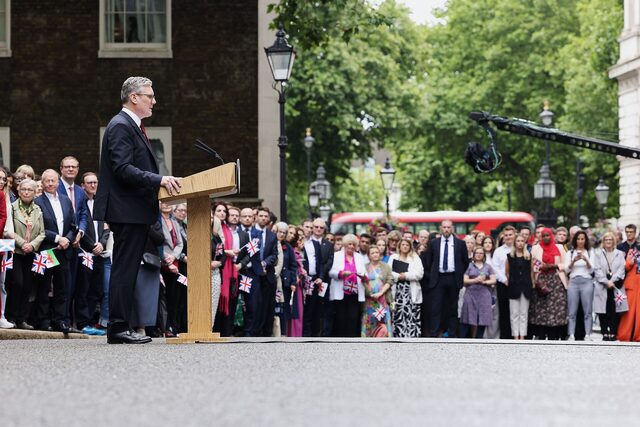
Keir Starmer resigns as UK Labour leader
Rory Arnold/ No 10 Downing · OGL 3
30-DAY PEAK
99
modeled window
90-DAY AVG
65
stable
TREND SCORE
92
-5% · 24h
TRACKED QUESTIONS
9
from public queries
INTEREST OVER TIME
Momentum trajectory
PEAK 99
30d ago15dtoday

The context

UK Prime Minister Keir Starmer announced on June 22, 2026 that he would step down as leader of the Labour Party, saying he was not the right person to lead the party into its next general election campaign. The announcement, delivered in an emotional statement outside Downing Street, came less than two years after Labour’s historic 2024 general election landslide, one of the biggest majorities in British political history.

The resignation ends a turbulent and often demoralising chapter for a party that entered government in July 2024 with enormous expectations. Within months, rampant cost-of-living pressures, a series of internal controversies, and the stratospheric rise of Nigel Farage’s Reform UK dismantled Labour’s poll lead at speed. The May 2026 local elections, where Reform made major gains at Labour’s expense in traditional heartlands, removed any last ambiguity. Senior cabinet ministers and backbenchers began briefing against the leadership openly, and Starmer’s position became increasingly untenable.

Starmer will remain as Prime Minister until a new Labour leader is elected, a process the party aims to complete before Parliament returns in September. Nominations open on July 9 and close on July 16. Andy Burnham, who stood down as Mayor of Greater Manchester to return to Parliament via the Makerfield by-election just four days before the resignation announcement, is the clear frontrunner. A Burnham premiership would make him Britain’s seventh Prime Minister in ten years, a staggering figure that reflects a decade of political upheaval, from Brexit to economic crisis to Reform’s insurgency.

People also ask

9 questions · sorted by search share

Starmer said he was not 'best placed' to lead the Labour Party into the next general election. His resignation followed a collapse in Labour's poll ratings, heavy losses in May 2026 local elections, and the rapid rise of Nigel Farage's Reform UK, which had overtaken Labour in several national polls. Pressure from Labour MPs and cabinet ministers, frustrated by the government's direction and their electoral prospects, had been mounting for months.

Yes, for now. Starmer announced he will remain Prime Minister until a new Labour leader is chosen. Nominations open on July 9 and close July 16, with a leadership contest expected to conclude before Parliament returns in September 2026. He will hand over the keys to Downing Street to whoever wins the Labour leadership election.

The most likely successor is Andy Burnham, the former Mayor of Greater Manchester, who returned to Parliament by winning the Makerfield by-election on June 18, 2026, a move widely interpreted as a leadership run. Burnham has confirmed he will stand, and secured early support from Health Secretary Wes Streeting. No other major candidates had declared at the time of writing, though the nomination window does not open until July 9.

Andy Burnham, born January 7, 1970, is a British Labour politician who served as Mayor of Greater Manchester from 2017 to 2026 and was MP for Leigh from 2001 to 2017. He has previously run for the Labour leadership twice, in 2010 and 2015. He returned to Parliament in June 2026 by winning the Makerfield by-election, a move widely read as positioning for the leadership.

Starmer became Prime Minister in July 2024 after Labour's landslide general election victory. His resignation announcement on June 22, 2026 means he served less than two years as Prime Minister, one of the shorter tenures in modern UK political history.

Reform UK, led by Nigel Farage, surged in the 2026 local elections and overtook Labour in several national polls, an extraordinary shift for a party that won only five seats in the 2024 general election. Reform's anti-immigration, anti-establishment message has pulled support from traditional Labour voters in the Midlands and the North, hollowing out Starmer's core coalition at remarkable speed.

If Andy Burnham becomes PM as expected, the UK will have had seven Prime Ministers in roughly ten years: David Cameron (resigned 2016), Theresa May (resigned 2019), Boris Johnson (resigned 2022), Liz Truss (resigned 2022 after 45 days), Rishi Sunak (defeated 2024), Keir Starmer (resigning 2026), and Burnham. The turnover reflects a decade of political instability, from Brexit to economic shocks to Reform's insurgency.

Nominations open on July 9, 2026 and close on July 16. The Labour Party aims to install a new leader before Parliament returns in September 2026. The precise voting timetable had not been published at the time of writing, but the party has indicated the process will be swift given the need for stable government leadership.

Not immediately. Starmer's resignation as Labour leader does not trigger a general election, a new Labour leader will become Prime Minister by convention, without a public vote. The next UK general election is not due until 2029. However, if the new PM's position becomes untenable, or if a vote of no confidence passes in the Commons, an earlier election could be forced.

INTEREST BY REGION
Where it's trending
United States
100
India
83
France
73
United Kingdom
53
Germany
53
Brazil
44
Japan
15
Canada
14
Sources
bbc
guardian
cnbc
al-jazeera
time
npr
Public-source data, structured and editorially reviewed.