Skip to content
datastats

2026 Ebola outbreak (DR Congo)

▲ Hot Trend score: 84 Published: June 3, 2026

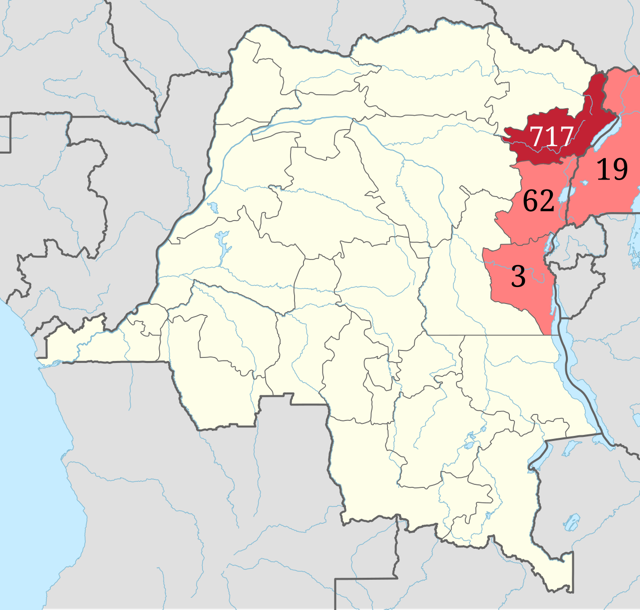
The WHO has declared a Public Health Emergency of International Concern over a 2026 Ebola outbreak centred in DR Congo's Ituri province — one of the largest since the virus was first identified roughly 50 years ago.

The context

Why “2026 Ebola outbreak” is everywhere right now

On 16 May 2026, the World Health Organization escalated the ongoing Ebola crisis in Central Africa to a Public Health Emergency of International Concern (PHEIC) — the highest alarm level in global health. That declaration is what pushed this story from regional news to global trending status overnight.

The outbreak is concentrated in the Democratic Republic of the Congo, primarily in Ituri province, but it has already crossed a border: Uganda has confirmed roughly 15 cases, including at least one death, with some cases involving the Bundibugyo strain of the virus. As of around 1–2 June 2026, the DRC had reported approximately 320–330 confirmed cases and 48–49 deaths — figures that are provisional and updated continuously by the WHO and national health ministries.

The scale matters. Experts have described this as among the largest Ebola outbreaks since the virus was identified approximately 50 years ago, placing it in the same conversation as the catastrophic 2013–2016 West Africa epidemic. The cross-border spread to Uganda is precisely the kind of development that triggers international concern and, understandably, public fear.

A PHEIC declaration does not mean a pandemic is imminent — it is a formal mechanism to mobilise international resources, coordinate response, and accelerate access to vaccines and treatments. The WHO and affected national ministries are the authoritative sources for current case counts and official guidance.

People also ask

How many people died from Ebola in 2026?#
As of approximately 1–2 June 2026, the DRC had reported around 48–49 deaths from the current outbreak, with at least one additional death in Uganda. These are provisional figures — they change daily, and the WHO and national health ministries are the only reliable sources for up-to-date numbers.
Is there an Ebola outbreak in Congo?#
Yes. An active Ebola outbreak is centred in the Democratic Republic of the Congo, primarily in Ituri province, and has been serious enough for the WHO to declare it a Public Health Emergency of International Concern on 16 May 2026. With roughly 320–330 confirmed cases reported by early June 2026, this is a major, ongoing crisis.
Can you still get Ebola in 2026?#
Yes. Ebola has never gone away — it resurfaces periodically in Central and West Africa, and there is an active outbreak right now in the DRC and Uganda. Infection requires direct contact with the bodily fluids of a symptomatic person or an infected animal, so the risk for people outside affected regions is very low but not theoretically zero.
Will there be an Ebola pandemic?#
Ebola is not well-suited to pandemic spread — it is not airborne, and it requires close contact with infectious bodily fluids, which limits its ability to move the way a respiratory virus does. Every major outbreak so far has been contained. That said, cross-border spread to Uganda and the PHEIC declaration show why vigilance and rapid international response are non-negotiable right now.
Will Ebola reach the US?#
It is possible for individual imported cases to occur — it happened in 2014 when a traveller from West Africa brought Ebola to Dallas. What is extremely unlikely is sustained community transmission in a country with robust infection-control infrastructure. The CDC and public health authorities maintain surveillance protocols specifically to detect and contain any such importation.
Is Ebola 100% fatal?#
No. Ebola's case fatality rate varies by outbreak and strain — it has ranged historically from roughly 25% to 90%, depending on the virus variant and the quality of care available. Improved supportive care and, more recently, approved treatments have pushed survival rates significantly higher than they were in early outbreaks.
Who was patient 0 for Ebola?#
The very first documented Ebola patient — the index case in the 1976 outbreaks — was a schoolteacher in Yambuku, DRC (then Zaire), though historical research has also pointed to earlier, undetected cases. 'Patient Zero' for any specific outbreak is identified through contact-tracing after the fact, and the index case for the current 2026 outbreak has not been publicly confirmed in verified reporting.
Has the US ever had an Ebola outbreak?#
Not a domestic outbreak in the traditional sense, but the US did have a serious scare in 2014 when Thomas Eric Duncan, who had travelled from Liberia, was diagnosed in Dallas and died there. Two nurses who cared for him were also infected but survived. That episode exposed gaps in hospital preparedness and led to major protocol overhauls.
Is there Ebola in the US?#
No confirmed cases of Ebola in the US have been reported as part of the current 2026 outbreak, based on available verified information. The CDC actively monitors for any potential imported cases and coordinates with international health authorities; check CDC.gov for the most current status.
What animal is immune to Ebola?#
No animal is definitively 'immune,' but fruit bats — particularly species in the genus Rousettus and related families — are widely regarded as the most likely natural reservoir of Ebola viruses, meaning they can carry and spread the virus without appearing to get sick. The exact mechanisms of their tolerance are still an active area of scientific research.
Is Ebola curable now?#
Two monoclonal antibody treatments — Inmazeb (atoltivimab/maftivimab/odesivimab) and Ebanga (ansuvimab) — were approved by the US FDA and have shown strong efficacy against the Zaire strain of Ebola, dramatically improving survival odds when administered early. They are not a guarantee, and their effectiveness against all strains (including Bundibugyo, which is present in the current Uganda cases) varies, but calling Ebola an automatic death sentence is no longer accurate.
Did Ebola ever reach the USA?#
Yes. During the 2014–2016 West Africa epidemic, a small number of cases were diagnosed on US soil — most notably the Dallas case involving a Liberian traveller, and a few healthcare workers who contracted the virus abroad and were medically evacuated for treatment. There was no sustained US outbreak.
What country has the highest rate of Ebola?#
The Democratic Republic of the Congo has experienced more Ebola outbreaks than any other country — over a dozen since the virus was first identified in 1976 on the banks of the Ebola River within its borders. The current 2026 outbreak, centred in Ituri province, is the latest and one of the largest chapters in that grim history.
Is Ebola still a thing in Africa?#
Yes, very much so. Ebola is endemic to Central and West Africa, with outbreaks recurring in the DRC, Uganda, Guinea, and other countries over the decades. The current 2026 crisis — with hundreds of confirmed cases and a WHO emergency declaration — is the clearest possible proof that Ebola never stopped being a real and active threat.
What was the worst Ebola outbreak in the world?#
The 2013–2016 West Africa epidemic — centred on Guinea, Sierra Leone, and Liberia — is by far the largest and deadliest Ebola outbreak on record, with over 28,000 cases and more than 11,000 deaths. The current 2026 outbreak in DRC and Uganda is described as among the largest since the virus was identified, but has not yet approached those catastrophic numbers.
Is Ebola still a death sentence?#
No, not categorically. The development of approved monoclonal antibody therapies has significantly improved survival rates, particularly for the Zaire strain. That said, outcomes still depend heavily on how quickly treatment begins and what quality of healthcare is accessible — in remote or under-resourced areas, Ebola remains extremely dangerous and often fatal.
How did patient 0 get Ebola?#
Historically, index cases of Ebola outbreaks are believed to have acquired the virus through contact with infected animals — most likely fruit bats or animals that had themselves been exposed to bats. The specific route of infection for the index case of the 2026 outbreak has not been publicly confirmed in verified reporting, and public health investigators typically determine this through retrospective contact tracing.
Is there a cure for Ebola now?#
There are approved treatments — specifically two monoclonal antibody therapies (Inmazeb and Ebanga) — that have proven highly effective against the Zaire Ebola strain when given early, and a preventive vaccine (rVSV-ZEBOV, marketed as Ervebo) is also available. These are not universal cures for all Ebola virus species, but they represent a genuine scientific breakthrough compared to the situation a decade ago.
What country was hit hardest by Ebola?#
Liberia suffered the highest death toll during the 2013–2016 West Africa epidemic, losing over 4,800 people — a devastating blow for a small country still recovering from civil war. In terms of total historical outbreak frequency, the Democratic Republic of the Congo holds the grim record, and it is the epicentre of the current 2026 emergency.
Is there any Ebola left?#
Yes — Ebola viruses persist in animal reservoirs in nature and are not eradicable the way smallpox was. The current 2026 outbreak in DRC and Uganda is live proof of that. Between outbreaks the virus is not gone; it is simply circulating in wildlife, waiting for the next spillover event into humans.

Sources

  • manual_validated
  • wikipedia_export

Related topics