The G7 and G20
The G7 and the G20 are the world's two most powerful informal clubs, neither with a treaty nor a permanent secretariat. The 52nd G7 summit was held in Evian-les-Bains, France on June 15-17, 2026 and produced nine declarations, with the United States taking over the G7 presidency for 2027. The United States also holds the G20 presidency in 2026, which it assumed on December 1, 2025: the leaders' summit is set for December 14-15, 2026 at Trump National Doral in Miami, preceded by a G20 foreign ministers' meeting in Atlanta on October 30-31. Sources: Elysee, G20 Miami 2026, US State Department, G7 Research Group.
The context
The G7 and G20, explained
Two acronyms dominate international news cycles whenever the world’s biggest economies need to coordinate: the G7 and the G20. Both are intergovernmental forums, informal by design, with no founding treaty and no permanent secretariat, that hold annual summits to tackle economic and political challenges on a global scale.
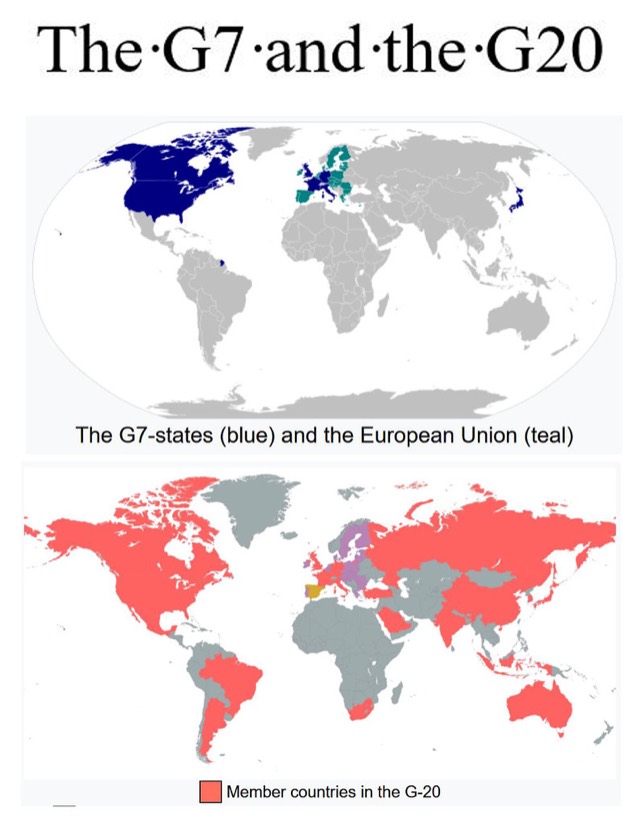
The G7 (Group of Seven) brings together seven of the world’s most advanced industrialised democracies: Canada, France, Germany, Italy, Japan, the United Kingdom, and the United States, with the European Union also participating. It operates on a rotating annual presidency, whichever country holds the chair sets the agenda and hosts the summit that year.
The G20 (Group of Twenty) is the broader forum. It includes the G7 nations plus twelve major emerging and developing economies, among them China, India, Brazil, Russia, Saudi Arabia, South Africa, Indonesia, Mexico, Turkey, South Korea, Argentina, and Australia, alongside the EU. Since 2023, the African Union has also joined as a full member, bringing the total to 21 members.
These bodies are trending because their summits are regularly flashpoints for geopolitical tension, trade disputes, climate commitments, and debt relief negotiations. Whenever leaders gather, the gap between the G7’s consensus-driven Western bloc and the G20’s broader, often divergent membership makes headlines.
52nd G7 Summit, Evian-les-Bains, France (June 15-17, 2026). Hosted by Emmanuel Macron, the summit opened the same day President Trump and Vice-President Vance signed the US-Iran Memorandum of Understanding. The Iran deal and the reopening of the Strait of Hormuz dominated the agenda, alongside continued support for Ukraine, with President Zelenskyy joining a working session, competition with China over critical minerals, and AI governance. France broke with the usual outreach format by involving India, Kenya, South Korea, Brazil and Egypt throughout the discussions rather than in a single side session. The summit closed with nine declarations and a reaffirmed G7 line on Ukraine’s sovereignty and territorial integrity, and with France handing the presidency to the United States for 2027.
G20 2026: the United States in the chair. Washington assumed the G20 presidency on December 1, 2025, and has set its priorities as cutting regulatory burden, expanding reliable and affordable energy, and advancing new technologies. The ministerial track runs through the autumn, with Secretary of State Marco Rubio hosting the G20 foreign ministers in Atlanta on October 30-31, 2026. The leaders’ summit is on December 14-15, 2026 at Trump National Doral in Miami, the first G20 summit the United States has hosted since Pittsburgh in 2009, and it falls in the country’s 250th anniversary year. With the G7 chair passing to Washington immediately afterwards for 2027, the United States will sit at the head of both tables back to back. Sources: Elysee, G20 Miami 2026, US State Department, G7 Research Group.
For the wider club of developed economies, see the full OECD countries list.
For the Asia-Pacific side of those memberships, see the APAC countries list.