Rammstein
Rammstein are the most controversial band on the planet — banned in some venues, accused of plenty, and still selling out stadiums by the hundreds of thousands.
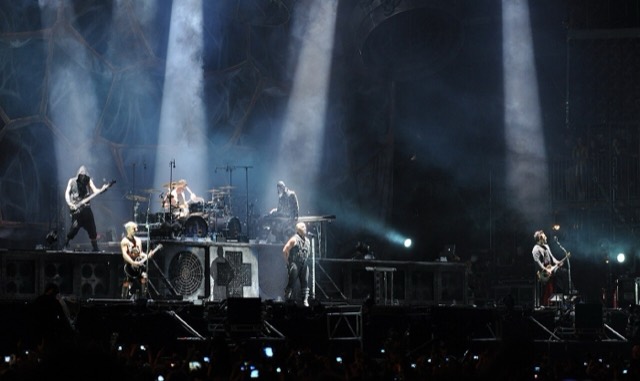
Rammstein are a German Neue Deutsche Härte band formed in Berlin in 1994, built around vocalist Till Lindemann, guitarist Richard Kruspe, and four other tight-knit members. Their signature is pyrotechnic live shows so explosive they routinely require fire department permits, paired with heavy industrial riffs and lyrics that weaponise the German language like a blunt instrument. They are, by any metric, the biggest German rock band in history.
They broke internationally with their appearance on the Lost Highway soundtrack in 1997, and never looked back. Albums like Sehnsucht, Mutter, and Rammstein (the 2019 self-titled record) all charted at number one across Europe. Their stadium tours routinely sell out within minutes, and their YouTube catalogue has accumulated billions of views — remarkable for a band that sings almost exclusively in German.
What keeps them in the search trends is not just the music but the permanent controversy machine surrounding them. Their videos court censorship, their lyrics wade into sadomasochism, war, and taboo desire, and their visual aesthetic deliberately borrows — and subverts — totalitarian imagery. That trolling of both conservative sensibilities and lazy critics is a core part of the brand.
In 2023, serious allegations of sexual misconduct against Till Lindemann surfaced from multiple women, reported widely across European media. The band denied the allegations; no criminal charges have been filed as of mid-2025. The controversy significantly dented their public image and led to the cancellation of some partnerships, but the band continued to tour and release music.
The combination of genuine musical power, theatrical extremity, and real-world scandal makes Rammstein one of the most-searched bands online — people come for the spectacle and stay because the story never stops moving.
People also ask
- Why is rammstein banned?#
- Rammstein are not universally or officially banned anywhere as a band, but specific songs, videos, and performances have been restricted or refused by individual broadcasters, venues, and countries. The reasons vary: provocative imagery, explicit sexual content in videos like 'Pussy,' and deliberate use of totalitarian visual aesthetics have all triggered bans or restrictions in specific contexts. The word 'banned' gets thrown around loosely — most of the time it means a single TV channel or venue said no, not a government-level prohibition.
- Why is rammstein banned from australia?#
- Rammstein are not banned from Australia. They have performed there and their music is freely available. What likely fuels this myth is that some of their music videos have been refused airplay by broadcasters, and their 'Pussy' video received an adults-only classification in several countries. If you've read a specific claim about an Australian ban, it is almost certainly misinformation.
- What is the most banned song of all time?#
- That title is fiercely contested, but 'God Save the Queen' by the Sex Pistols (1977) is one of the most documentedly banned songs ever, blocked by the BBC and major UK broadcasters upon release. Serge Gainsbourg's 'Je t'aime… moi non plus' was banned by the Vatican and multiple European broadcasters. In terms of sheer geographic spread of censorship, John Lennon's 'Imagine' and N.W.A's 'F*** tha Police' also rank extremely high. No single song holds an undisputed crown.
- How rich is Till Lindemann?#
- Lindemann's exact net worth is not publicly confirmed by any reliable financial disclosure. Various entertainment websites throw out figures in the range of $10–20 million USD, but these are estimates with no verified sourcing. What is not in dispute: he is the frontman of one of the world's highest-grossing rock acts, has released solo albums, and has published poetry — so he is, by any reasonable inference, extremely wealthy. Treat any specific number you read online as an educated guess.
- Which band inspired Rammstein?#
- Rammstein have cited Laibach, the Slovenian industrial provocateurs, as a foundational influence — their use of totalitarian imagery and confrontational performance art runs directly through Rammstein's DNA. They've also pointed to Oomph!, fellow Germans who pioneered Neue Deutsche Härte, as well as Nine Inch Nails and Ministry for the industrial heaviness. Richard Kruspe has named Depeche Mode as a personal touchstone for electronic texture and emotional depth.
- What rammstein song is banned in germany?#
- No Rammstein song is outright banned by German law. However, early in their career, the music video for 'Stripped' — which used footage from Leni Riefenstahl's 1936 Nazi Olympics film — was heavily criticised and some broadcasters refused to air it. The band argued it was a deliberate deconstruction of that imagery rather than an endorsement. Germany's strict laws around Nazi symbols and incitement mean that any art flirting with that visual territory faces intense scrutiny, but legal prohibition is a different matter.
- Where is rammstein banned from?#
- There is no country that has issued a blanket legal ban on Rammstein as a band. Specific videos have been refused by individual TV networks in various countries, and the 'Pussy' video triggered adults-only restrictions in several markets. The perception of Rammstein as 'banned everywhere' is largely a myth amplified by their own provocateur reputation — and probably by their own marketing instincts.
- Why rammstein is banned from america?#
- Rammstein are not banned from America. They regularly tour the United States, sell out major venues, and their music is freely available on all platforms. This question is almost entirely based on misinformation circulating on social media. No U.S. federal or state authority has prohibited them from performing or distributing music.
- Why is rammstein problematic?#
- There are several layers. First, their artistic output deliberately provokes: lyrics about incest, cannibalism, sadomasochism, and war, delivered with a straight face and industrial fury. Second, their use of imagery echoing Nazi-era aesthetics — always framed as critique, but giving ammunition to critics who say the line is too thin. Third, and most concretely, in 2023 multiple women publicly alleged a systematic pattern of predatory sexual behaviour centred on Till Lindemann and the band's touring operation; the allegations were reported extensively by outlets including Der Spiegel. The band denied wrongdoing; no criminal charges had been filed as of mid-2025.
- Why is rammstein so weird?#
- Because weird is the strategy, not the accident. Rammstein come from the East German post-reunification cultural landscape — a context of collapse, displacement, and identity crisis — and they metabolised that strangeness into art. Their lyrics deploy clinical, almost bureaucratic German to describe the most extreme human impulses, creating a deliberate dissonance. The pyrotechnics, the S&M staging, the deadpan delivery — it's all precision-engineered to make you feel uncomfortable and exhilarated at the same time.
- Why is rammstein hated?#
- The hate comes from multiple directions that don't agree on anything else. Some conservatives find their sexual explicitness and sadomasochistic imagery morally repugnant. Some on the left have accused them of irresponsible flirtation with fascist aesthetics, regardless of intent. And since 2023, a significant portion of former fans walked away following the sexual misconduct allegations against Lindemann. When your band is hated by both the far right and the progressive left simultaneously, you're probably doing something right artistically — but the 2023 allegations introduced a criticism that is harder to deflect as mere artistic misunderstanding.
- Is Rammstein allowed in the US?#
- Yes, completely. Rammstein have toured the United States repeatedly and face no legal prohibition whatsoever on performing or selling music there. They have played arenas and stadiums across North America without issue. The idea that they are restricted in the U.S. is baseless.
- Is Rammstein right or left wing?#
- Neither — and both would reject them. Rammstein have consistently refused to align with any political party or ideology, using provocation as a tool against all sides. Their 2019 video 'Deutschland' was explicitly critical of German nationalism and received praise from some left-leaning critics. However, their use of totalitarian imagery has led some on the left to accuse them of normalising fascist aesthetics. The band themselves have stated publicly they are not right-wing and have condemned neo-Nazis; multiple neo-Nazi groups in Germany have reportedly been told to stop using their music.
- Do Rammstein support LGBTQ?#
- Yes, in demonstrable ways. The 'Mann gegen Mann' (Man Against Man) video in 2005 was an explicit celebration of gay male sexuality and was one of the most overt pro-LGBTQ statements a mainstream rock band had made at that point. Keyboardist Christian 'Flake' Lorenz has spoken supportively of LGBTQ rights. The band has not, however, made sweeping political endorsements, preferring to let the art speak — which, in this case, speaks pretty loudly.
- Will there be a Rammstein tour in 2026?#
- As of mid-2025, no Rammstein 2026 tour dates have been officially announced. The band completed major European stadium runs in 2023 and 2024. For the most current information, the only reliable source is their official website at rammstein.com — anything else is rumour. Given their cadence, a 2026 run is plausible but unconfirmed.
- What does "du hast me" mean in German?#
- The phrase is actually 'Du hast mich' — 'Du hast me' is not grammatically correct German. 'Du hast mich' literally means 'You have me,' but the song is built on a deliberate pun: 'Du hasst mich' means 'You hate me.' The two phrases sound nearly identical when sung, and Rammstein exploit that ambiguity throughout the entire track. The 'me' you're thinking of is just an anglicised mishearing of 'mich.'
- What is the #1 German band of all time?#
- By global commercial impact, it's a two-horse race between Rammstein and Scorpions — and most data points to Scorpions edging it historically, with over 100 million records sold worldwide and anthems like 'Wind of Change' achieving genuine cross-cultural ubiquity. Rammstein, however, have a strong argument for the 21st century: they are the best-selling German act of the streaming era and their stadium tours dwarf almost any European rock act. It depends on your metric, but neither answer is wrong.
- What does "du hast" actually mean?#
- 'Du hast' means 'You have' in German — the second-person singular present tense of the verb 'haben' (to have). The genius of the Rammstein song is that it sounds identical to 'du hasst,' meaning 'you hate,' from the verb 'hassen.' The song opens that ambiguity intentionally and then subverts a traditional marriage vow ('will you love and honour…?'), making the whole thing a meditation on commitment, hatred, and whether there's much difference between the two.
- What is Rammstein's most famous song?#
- 'Du Hast' is almost certainly the answer by any measurable standard — radio play, streaming numbers, sync placements in films and TV, and cultural recognition all point to it as their signature track. Released in 1997, it was their international breakthrough and remains the entry point for most new listeners. 'Sonne,' 'Engel,' and 'Deutschland' are all strong runners-up with massive streaming numbers, but 'Du Hast' is the one everyone knows even if they can't name the band.
- What does Metallica think of Rammstein?#
- Metallica have been publicly and genuinely enthusiastic about Rammstein. James Hetfield has praised them on multiple occasions, and crucially, Metallica personally selected Rammstein as a support act for tour dates — which is about as clear an endorsement as one band can give another. Lars Ulrich has also spoken favourably about them in interviews. The mutual respect is real and well-documented, not just polite industry small-talk.