← BRANDS
datastats / Money
LIVE
Money

Kinder

Kinder is a multi-billion-dollar candy empire built by Ferrero, and its most iconic product has been banned in the United States for over 40 years, making it one of the most legally scrutinized chocolate eggs on the planet.
By · datastats · Updated June 4, 2026
Kinder
Adiel lo · CC BY-SA 3.0

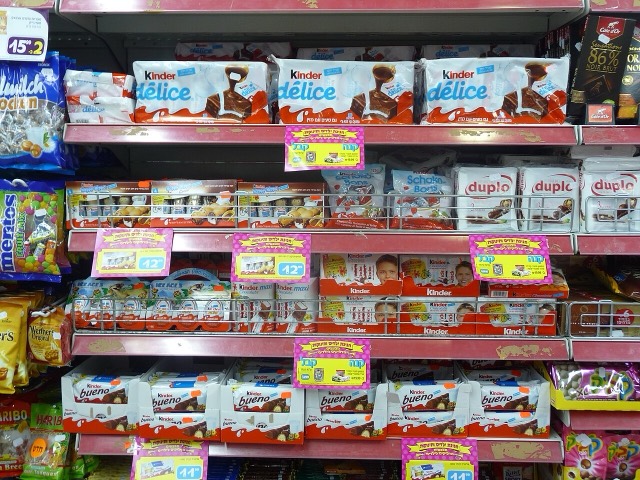
Kinder is a confectionery brand owned by Italian giant Ferrero, the same company behind Nutella and Ferrero Rocher. Launched in 1968, the brand’s name is the German word for “children,” and it was deliberately positioned as a premium treat for kids, with a marketing angle that emphasized quality ingredients (notably a higher milk content than standard chocolate). Today, Kinder is sold in over 170 countries and generates billions in annual revenue for Ferrero.

The brand’s portfolio spans a wide range of products: Kinder Surprise (the original chocolate egg with a toy inside), Kinder Joy (a split-egg format sold in markets where the original is banned), Kinder Bueno, Kinder Chocolate, Kinder Schoko-Bons, and Kinder Cards, among others. Each product targets a slightly different consumer, Bueno goes after teens and adults, while Joy and Surprise are squarely aimed at young children.

Most of the internet’s questions about Kinder revolve around one thing: the US ban. The original Kinder Surprise has been prohibited in America since 1938 legislation was tightened, because US law forbids embedding a non-food object inside confectionery. This makes Kinder arguably the world’s most famous contraband candy, customs agents seize thousands of eggs at the border every year.

The ban also explains Kinder Joy’s entire reason for existing. Rather than one chocolate shell encasing a toy, Kinder Joy splits the egg in two: one half is chocolate cream and wafers, the other is the toy. No food surrounds the toy. It’s a regulatory workaround, and it worked, allowing Ferrero to enter the massive US market. Yet confusion persists online, with many users unsure which products are actually banned and where.

On the financial side, Kinder’s pricing sits well above generic chocolate competitors, a gap that raises eyebrows, especially for Kinder Joy, which delivers a small amount of chocolate for a comparatively high price. Ferrero’s premium positioning, heavy marketing spend, and toy licensing costs all feed into that price tag, but the brand has never been particularly forthcoming about its margin structure. Ferrero remains a private, family-controlled company, so detailed financials are not publicly disclosed.

People also ask

Kinder Joy is not widely banned, it was specifically engineered to be legal in markets where the original Kinder Surprise is prohibited. The United States was its primary target market, and it is sold legally there. The original Kinder Surprise (one chocolate shell, toy inside) is the product that faces bans, most notably in the US.

The original Kinder Surprise egg is banned in the **United States**, where federal law (the Federal Food, Drug, and Cosmetic Act) prohibits embedding non-food objects inside confectionery. Canada briefly had restrictions but has since allowed them with updated packaging. The US remains the most prominent and strictly enforced ban, with CBP agents authorized to confiscate and fine travelers who bring them across the border.

Kinder Joy itself is **not** banned, that's a widespread misconception. It was redesigned precisely to comply with US law by physically separating the toy from the food. If you've seen claims that Kinder Joy is banned somewhere, they are either outdated, referring to the original Kinder Surprise, or based on local import regulations in a specific smaller market, not a broad ban.

The Federal Food, Drug, and Cosmetic Act of 1938 bans any candy that contains a non-nutritive object embedded inside it, the legal logic being that children could choke on or swallow the toy without realizing it's there. Kinder Surprise, with its plastic capsule sitting inside a chocolate shell, fits that definition perfectly. The FDA and US Customs have enforced this consistently for decades, regardless of how popular the product is in the rest of the world.

Several factors drive the price: Ferrero is a premium brand that prices on image as much as ingredients, the toy inside requires its own design, licensing, and manufacturing supply chain, and the dual-compartment packaging costs more to produce than a standard chocolate bar. Import costs (where applicable) and retailer margins on novelty items also inflate the shelf price. You're paying for the experience and the brand cachet, the actual chocolate volume is modest.

It isn't, Kinder Joy is **legal and widely sold in the US**. This is one of the most persistent myths about the brand. Kinder Joy was reformulated specifically to comply with American law: the toy and the food occupy separate compartments and never touch. Walk into any Walmart or Target in the US and you'll find it on the shelf.

Because US federal law explicitly forbids confectionery that has a non-food object fully embedded inside it, a rule designed to prevent choking hazards, particularly for young children. The Kinder Surprise egg encases a plastic toy capsule within chocolate, which falls squarely under that prohibition. The ban is not a recent political decision; it is decades-old legislation that Ferrero has worked around through product redesign rather than lobbying to change.

Kinder Joy is **not** banned in America, this is a myth, plain and simple. The banned product is Kinder Surprise. Kinder Joy was created as a legal alternative for exactly this market. Ferrero invested in redesigning the product so the toy sits in its own sealed half of the egg, never embedded in food, which satisfies US law.

No, at least not by Ferrero's own choice. Ferrero, Kinder's parent company, has not announced any boycott of Israel. However, Kinder (along with many other major consumer brands) has been *targeted* by pro-Palestinian boycott campaigns, particularly after the Gaza conflict escalated in 2023. Whether consumers choose to participate in those boycotts is a personal decision, but Ferrero itself has not taken a political stance publicly on the matter.

Yes, the original **Kinder Surprise** eggs are banned in the United States under federal food safety law. US Customs and Border Protection can confiscate them and fine individuals up to $2,500 per egg for bringing them into the country. Kinder Joy, the redesigned alternative, is legal and sold throughout the US.

"Kinder" is the German word for "children," and Ferrero chose it deliberately to signal that the brand was made with kids in mind. Ferrero's founder, Pietro Ferrero, was Italian, but German carried a connotation of quality and precision in post-war European consumer culture. The name also travels well across languages without sounding odd or offensive in major markets.

Kinder products are ultra-processed, high-sugar, high-fat confectionery, so yes, consumed regularly, they are not doing your health any favors. A single Kinder Joy egg packs around 110–130 calories, with a significant share coming from sugar and saturated fat. That said, no credible nutritionist is calling a single Kinder egg a health crisis; the problem, as with all candy, is habitual overconsumption, particularly in children.

In the context of the brand, **Kinder** means "children" in German. As a standalone English word (not related to the brand), "kinder" is the comparative form of "kind", meaning more kind, or more gentle. The brand uses the German meaning intentionally.

In English, synonyms for "kinder" (comparative of kind) include: more compassionate, more generous, more gentle, more benevolent, more considerate. In the German sense (children), synonyms or related words include: kids, youngsters, youths, minors, tots. The brand name itself has no synonym, it's a proper noun.

Yes. "Kinder" is the plural of "Kind" in German, meaning children. The singular is "ein Kind" (one child); the plural is "die Kinder" (the children). Ferrero named the brand using this plural form, positioning the entire product line as food made for children.

Ferrero's Kinder lineup includes: **Kinder Surprise** (the original banned-in-the-US chocolate egg with toy), **Kinder Joy** (the legal split-egg alternative), **Kinder Bueno** (a wafer-and-hazelnut bar for older consumers), **Kinder Chocolate** (the classic milk-and-white-chocolate bar), **Kinder Schoko-Bons** (small praline-shaped bites), **Kinder Cards** (biscuit with chocolate cream), and **Kinder Country** (a cereal and chocolate bar). Product availability varies significantly by country.

If you mean the English adjective (more kind), you can substitute: more compassionate, more warm-hearted, more considerate, gentler, or more generous, depending on context. If you're asking for an alternative brand name or product, there is no true substitute for the Kinder brand itself; it's a proprietary name owned by Ferrero.

Here are 10 classic synonym pairs: happy/joyful, fast/quick, big/large, start/begin, smart/intelligent, brave/courageous, tired/exhausted, rich/wealthy, strange/peculiar, kind/benevolent. A synonym is a word that shares the same or very similar meaning as another word in the same language.

As an English adjective: "She was kinder to her colleagues after the meeting", here it means more kind. As a German noun (always capitalized in German): "Die Kinder spielen im Garten" (The children play in the garden). As a brand reference: "I bought a Kinder Bueno at the airport", treated as a proper noun, not declined or modified.

Yes, in two distinct ways. In English, "kinder" is a perfectly valid common word, the comparative form of the adjective "kind." In German, "Kinder" is a standard noun meaning children. As a brand name, "Kinder" is a proper noun owned by Ferrero. All three usages are legitimate; context determines which meaning applies.

Related topics
Money Trending now
Richest people in the world 2026
Money Trending now
How to cancel Amazon Prime
Money Trending now
Coinbase vs Binance
Money Trending now
How to cancel Adobe Creative Cloud
Money Trending now
Compound interest
Money People
Bernard Arnault
Money People
Mark Cuban
Money People
Mukesh Ambani