Skip to content
datastats

Compound interest

▲ Hot Trend score: 80 Published: June 4, 2026

Compound interest is the closest thing to a cheat code in personal finance — and it works just as brutally against you when you're in debt.
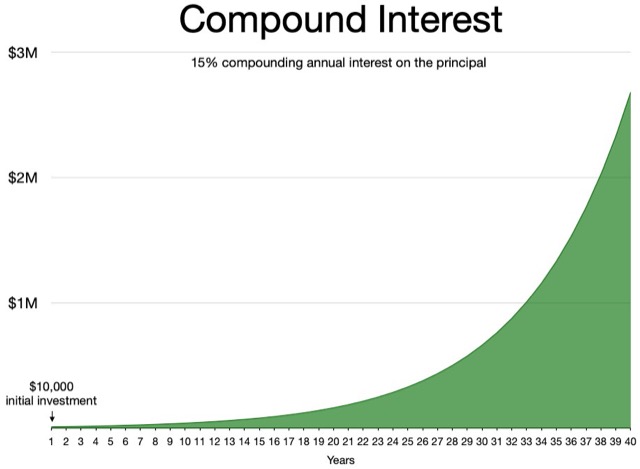
The context

Compound interest is trending because a new wave of financially curious people — largely Gen Z and millennials — are flooding search engines with basic-but-urgent money questions. Economic uncertainty, rising interest rates on both savings and credit cards, and a surge of personal finance content on social media have pushed the topic back into the spotlight.

The concept is deceptively simple: you earn interest not just on what you put in, but on everything that’s already accumulated. That feedback loop is what makes it so powerful — and so dangerous depending on which side of it you’re on.

The Rule of 72 has become a viral shortcut in finance communities: divide 72 by your annual return rate to estimate how long it takes your money to double. At 7%, that’s roughly 10 years. It’s a back-of-the-napkin estimate, not a guarantee — but it makes the math feel real and urgent.

What’s driving urgency right now is the debt side of the equation. Credit card interest rates have climbed sharply in recent years, meaning compound interest is actively working against millions of borrowers. The same mechanic that builds wealth for patient investors is quietly draining people who carry high-interest balances month to month.

General information only — not personalized financial, tax, or investment advice. No return is guaranteed; all investing involves risk of loss. Any figures cited are illustrative or historical, not forecasts. Always cross-check with an official source or a qualified financial professional.

People also ask

Is compounding interest worth it?#
Yes — if time is on your side and you're earning it, not paying it. Compound interest accelerates growth because every period's gains start generating their own gains. The catch: it's equally 'worth it' to the credit card company charging you 20%+ annually. Which side you're on makes all the difference.
Why is compound interest exponential?#
Because each new period's interest is calculated on a larger base than the last — the gains compound on themselves, not just on the original amount. That self-referential structure is the mathematical definition of exponential growth: the rate of increase is proportional to the current value. The longer it runs, the steeper the curve gets.
Is compound interest exponential?#
Yes, in behavior — though technically it's discrete exponential growth rather than a smooth curve, since interest is typically applied at set intervals (daily, monthly, annually). The end result looks and acts exponential: slow at first, then dramatically accelerating over time. That's precisely why starting early matters so much more than most people realize.
How much is $1000 worth at the end of 2 years if the interest rate of 6% is compound?#
Using the standard formula A = P(1 + r)^t, that's $1,000 × (1.06)² = $1,123.60 — assuming interest compounds annually. The extra $3.60 over simple interest (which would give $1,120) looks trivial at two years, but the gap widens dramatically over decades. This figure is illustrative; actual returns on any investment are not guaranteed.
Why is compound interest the 8th wonder of the world?#
The phrase captures how something so mathematically simple produces results that feel almost supernatural over long time horizons. Small, consistent contributions — left alone long enough — can dwarf much larger sums invested late. It's called a wonder because most people chronically underestimate exponential growth; the human brain is wired for linear thinking, not curves that go nearly vertical.
Why does compound interest work?#
It works because interest is repeatedly reinvested, so the earning base keeps growing. Each cycle, you're earning returns on returns — not just on your original principal. The three levers that determine the outcome are the rate, the frequency of compounding, and above all, time. Remove any one of them and the effect shrinks dramatically.
What is compounded interest?#
Compounded interest is interest calculated on both the original principal and all previously accumulated interest. Unlike simple interest — which only ever applies to the starting amount — compound interest creates a snowball effect. It's the foundational mechanic behind long-term investing, savings accounts, and unfortunately, most consumer debt.
Which bank gives 9.5% interest?#
No widely available savings account in the US or major Western markets is currently offering 9.5% as a standard rate — that figure is well above prevailing high-yield savings rates. Some regional banks, credit unions, or promotional products in certain countries may advertise rates in that range under specific conditions. Always verify current rates directly with the institution and read the fine print; advertised rates change and may have strict caps or eligibility requirements.
What is the downside of compound interest?#
The same engine that builds wealth destroys it when you're the borrower. High-interest debt — credit cards especially — compounds against you just as relentlessly as a good investment compounds for you. Miss payments, carry a balance, and the interest on your interest can make the original debt feel impossible to escape. Time, the great ally of the investor, becomes the enemy of the indebted.
What did Warren Buffett say about compound interest?#
Buffett has repeatedly credited compound interest — and starting early — as core to his wealth-building approach. He has described his fortune as a product of living in America, good genes, and compound interest working over decades. However, the verified facts provided here don't include a specific verbatim quote, so any exact wording you've seen attributed to him should be independently confirmed before treating it as authoritative.
Which compound interest is the best?#
The 'best' compound interest is the highest rate you can earn, compounding as frequently as possible, held for as long as possible — on money you're owed, not money you owe. In practical terms, daily compounding beats monthly beats annual at the same stated rate. But chasing a marginally higher compounding frequency matters far less than locking in a strong rate and leaving the money alone for years. This is general information, not a recommendation to buy or hold any specific product.
Who invented compound interest?#
No single inventor exists — compound interest evolved over millennia. Evidence of compound interest calculations dates back to ancient Mesopotamia, with clay tablets showing sophisticated lending practices thousands of years ago. It was formalized mathematically during the Renaissance, and Jacob Bernoulli's 17th-century work on continuous compounding helped lay the theoretical groundwork that still underpins modern finance.
Who said compound interest is the 8th wonder?#
This quote is almost universally attributed to Albert Einstein, but there is no verified historical record of Einstein actually saying or writing it. It's almost certainly a misattribution — a catchy financial aphorism that got Einstein's name slapped on it to give it credibility. The sentiment is sound regardless of who coined it; the source, however, is unconfirmed at best.
Who offers compound interest accounts?#
Most banks and financial institutions offer accounts where interest compounds — including standard savings accounts, high-yield savings accounts, money market accounts, and certificates of deposit (CDs). Brokerage accounts and retirement accounts (like 401(k)s and IRAs) also benefit from compounding as dividends and gains are reinvested. The key variable is the rate, which differs widely between a basic checking account and a high-yield product.
Who does compound interest work?#
Compound interest works in favor of anyone earning it over time — patient investors, consistent savers, and long-term retirement account holders. It works against anyone paying it — primarily borrowers carrying high-interest debt like credit cards or certain personal loans. The mathematical mechanics are identical; the outcome is entirely determined by which side of the equation you're on.
Who use compound interest?#
Everyone in the financial system is touched by compound interest, whether they know it or not. Banks use it to grow deposits and charge borrowers. Investors rely on it to build retirement wealth. Governments and corporations pay it on bonds and loans. And millions of credit card holders are subject to it every month they carry a balance.
Who offers daily compound interest accounts?#
Many high-yield savings accounts and money market accounts compound interest daily — including products from major online banks and credit unions. Daily compounding means your balance earns a tiny sliver of interest every single day, which is then added to the base for the next day's calculation. The practical difference versus monthly compounding is small at typical retail rates, but it does add up over years. Check specific institutions' current terms directly, as offerings change.
Who to calculate compound interest?#
The formula is A = P(1 + r/n)^(nt) — where P is principal, r is annual interest rate (as a decimal), n is compounding periods per year, and t is time in years. Online compound interest calculators (available from most financial institutions and sites like Investor.gov) make this instant. For a quick doubling estimate, use the Rule of 72: divide 72 by the annual rate to get approximate years to double.
Who benefits from compound interest?#
Long-term savers and investors benefit most — especially those who start early and reinvest consistently. The math heavily rewards patience: someone who invests early and stops can outperform someone who invests larger amounts but starts late. Lenders and credit card companies also benefit enormously from compound interest paid by borrowers. The single biggest beneficiary is always the one with the most time.
What compound interest means?#
Compound interest means your interest earns interest. You deposit money, it earns a return, and that return is added to your balance — so next period, the entire larger balance earns a return. Repeat that cycle over years and decades, and the growth becomes dramatic. It's the foundational concept behind why starting to save early is one of the most consistently recommended moves in personal finance.

Sources

  • manual_validated
  • wikipedia_export

Related topics

Related products

As an Amazon Associate, datastats earns from qualifying purchases.