← BRANDS
datastats / Money
LIVE
Money

Heineken

Heineken is a Dutch brewing empire worth tens of billions of dollars, and the Heineken family still controls it, despite what every conspiracy theory on the internet wants you to believe.
By · datastats · Updated June 4, 2026
Heineken
Andybryant at English Wikipedia · Public domain

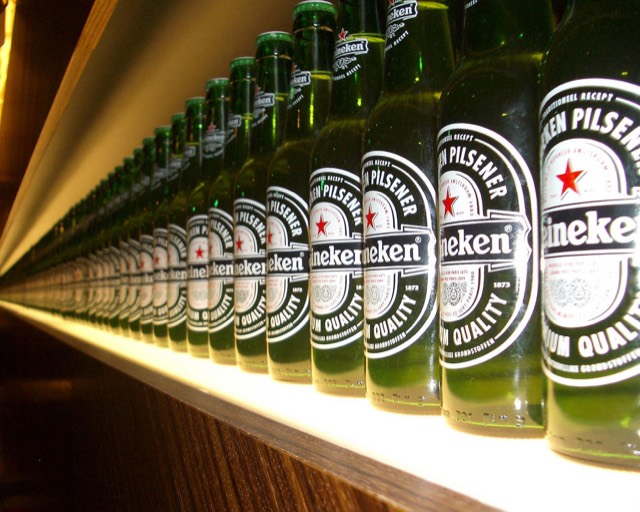
Heineken is one of the most recognisable beer brands on the planet, brewed in Amsterdam since 1873 by Gerard Adriaan Heineken. Today the Heineken N.V. group operates over 165 breweries across more than 70 countries, making it the world’s second-largest brewer by volume. The green bottle, the red star, and that distinctive, some say notorious, aroma are globally synonymous with “international lager.”

The money behind Heineken is what makes it genuinely interesting. The Heineken family holding company, L’Arche Green N.V. (controlled by Charlene de Carvalho-Heineken, the founder’s great-granddaughter), holds roughly 88% of Heineken Holding N.V., which in turn controls Heineken N.V. That single family dynastic grip on a €30 billion+ enterprise is rare in modern corporate life, and it is why the company is notoriously tight-lipped about its finances and strategy.

People search Heineken for money reasons constantly: Who really owns it? What is it worth? Who profits when you crack a green bottle? The brand’s global licensing, acquisition, and distribution web, spanning SABMiller buyout battles, Africa market dominance, and US import deals, makes the ownership map genuinely complicated, even if the family at the top never changes.

And then there are the product questions. Heineken is one of the most polarising mainstream beers in the world, loved in 190 countries, mocked by craft beer drinkers on every continent. The “skunky” debate alone has driven millions of searches. Whether you think it is the perfect session lager or an overpriced green-bottled disappointment, Heineken’s cultural footprint means it is always worth examining honestly.

People also ask

Heineken USA is a wholly owned subsidiary of Heineken N.V., the Dutch parent. It is the exclusive importer and marketer of Heineken-branded products in the United States. There is no separate American owner, the Dutch multinational calls the shots entirely, distributing through a network of US regional wholesalers.

Heineken controls its South African operations through Heineken Beverages, a business it fully took over after acquiring a controlling stake in Distell Group and Namibia Breweries in a landmark 2022–2023 deal worth roughly $2.6 billion. That acquisition made Heineken the largest beer and cider producer in Africa by volume. The brand had previously distributed through a partnership, but now owns the operation outright.

Heineken N.V. is the publicly listed operating company, but the controlling shareholder is Heineken Holding N.V., which is itself majority-controlled by L'Arche Green N.V., the family vehicle of Charlene de Carvalho-Heineken, the founder's great-granddaughter. She and her husband Michel de Carvalho effectively control one of the world's largest brewing empires through this layered holding structure. Institutional investors own minority stakes on the Amsterdam stock exchange, but real power sits firmly with the family.

Heineken UK Limited is a fully owned subsidiary of Heineken N.V. It is one of the UK's largest pub and beer businesses, owning Star Pubs & Bars, a managed and leased pub estate of roughly 2,400 pubs across Britain. Beyond the green bottle, Heineken UK brews and markets brands including Foster's, Strongbow, Birra Moretti, and John Smith's under licence or ownership in the British market.

Yes. Heineken is a pale lager, brewed with bottom-fermenting yeast at cold temperatures, the defining characteristic of the lager family. It ferments using a proprietary yeast strain Heineken calls "A-yeast," developed in-house in the 19th century. It sits at 5% ABV in its standard form and is classified specifically as a European pale lager.

Heineken's appeal is built on ruthless consistency, you crack a Heineken in Amsterdam, Lagos, or Tokyo and it tastes the same. The brand has spent 150 years refining a clean, crisp, mildly bitter pale lager that offends nobody and satisfies most. Its heavy investment in sports sponsorships (Champions League, Formula 1) has also embedded it as the aspirational global beer, which does a lot of heavy lifting for taste perception.

The most common knock on Heineken is the skunk, a lightstruck, sulphuric off-flavour that many drinkers detect, particularly from bottles (more on that below). Beyond that, craft beer drinkers dismiss it as a thin, mass-produced lager with little complexity. It is also significantly more expensive than comparable lagers without a flavour premium to justify the price gap, you are paying for the logo.

The green bottle is the culprit. UV and fluorescent light reacts with hop compounds in beer to produce 3-methyl-2-butene-1-thiol (MBT), a sulphur compound chemically similar to skunk spray. Brown bottles block this reaction; green bottles do not. Heineken has used a green bottle since the 1880s for brand identity reasons and has never switched, despite knowing the science. They partially address it by using hop extracts that are less light-sensitive, but the skunky reputation is baked in, literally.

No more or less than any other standard-strength beer. At 5% ABV and around 150 calories per 330ml bottle, Heineken is an alcoholic drink, and alcohol at any level carries well-documented health risks with regular consumption, including liver disease and increased cancer risk according to bodies like the WHO. The zero-alcohol version (Heineken 0.0) removes the ABV risk but keeps the calories. Drinking it occasionally will not kill you; making it a nightly habit is a different conversation.

Neither. Heineken is Dutch, founded in Amsterdam in 1873. The confusion with Irish probably comes from its green colour scheme (strongly associated with Ireland) and the fact that it is often sold prominently in Irish-themed pubs globally. The German association likely comes from the broader European lager tradition. But the brand, the family, and the original brewery are all unambiguously from the Netherlands.

No, not by any serious measure. Standard Heineken sits at 5% ABV, which is squarely average for a pale lager, the same as many Budweiser and Carlsberg variants. There is a Heineken Silver at 4% and a Heineken 0.0 at under 0.05% ABV. None of these are high-strength beers. For context, "strong" beer territory generally starts at 7–8% ABV and above.

Amsterdam, the Netherlands. Gerard Adriaan Heineken purchased the Haystack brewery on the Nieuwezijds Voorburgwal in Amsterdam in 1864, and by 1873 he had established the Heineken's Bierbrouwerij Maatschappij that still bears the family name. The original Amsterdam brewery is now the Heineken Experience museum; modern Dutch production has moved to a larger plant in Zoeterwoude.

"Clean" is doing a lot of work here and means different things depending on your concern, calories, additives, alcohol, or ingredients. In terms of short, simple ingredient lists, German-brewed beers adhering to the Reinheitsgebot (water, malt, hops, yeast only) are a solid benchmark. Light lagers like Michelob Ultra are frequently cited for low calorie counts (~95 calories). If you mean lowest alcohol, zero-ABV beers have expanded enormously in quality, brands like Athletic Brewing are widely praised. There is no single "cleanest" beer; it depends entirely on what you are trying to avoid.

Not exactly. Heineken 0.0 contains up to 0.05% ABV, which is how it is legally labelled "alcohol-free" in most markets, where the threshold is typically 0.5% ABV or below. That trace amount is comparable to what you find in fruit juice or bread. It is not zero, but it is functionally negligible for the vast majority of adults. People with specific medical or religious restrictions around any trace of alcohol should note the 0.05% figure.

No commercially produced beer sits at 75% ABV, at that level you are in spirits and distillate territory, not beer. The strongest beers ever made top out around 67.5% ABV: Scottish brewery Brewmeister produced "Snake Venom" (67.5% ABV) using freeze-concentration, a process that purists argue takes the result outside the technical definition of beer. Nothing mainstream or widely available reaches anywhere near 75%.

No. This is a persistent internet myth with no factual basis. Heineken is controlled by the Heineken family through their holding structure, as described above. Bill Gates's investment vehicle, Cascade Investment LLC, has held stakes in various consumer and agricultural companies over the years, but no credible, widely-reported source documents a meaningful ownership position in Heineken N.V. Do not believe this one.

Several beers hit the 8.1% ABV mark, it is not a unique fingerprint of one product. Peroni Nastro Azzurro Double Malt (8%) and various Belgian strong ales sit in this range. Colt 45 Double Malt (previously marketed at 8.5%) and King Cobra are well-known high-ABV American malt liquors in the ballpark. If you are searching for a specific product you tried, check the label, many craft IPAs and double IPAs cluster in the 7.5–9% range.

Not exactly, but roughly. A standard US "drink" is defined as 14 grams of pure alcohol, met by a 12oz beer at 5% ABV, a 1.5oz shot of 40% spirits, or a 5oz glass of wine. So one standard beer ≈ one standard shot in terms of alcohol load. Two standard beers therefore equal approximately two shots. The catch is that many craft beers exceed 5% ABV significantly, and many shots exceed 1.5oz, so "two beers" can easily represent three or more standard drinks depending on what you are actually pouring.

Brewmeister's "Armageddon" was marketed at 65% ABV and "Snake Venom" at 67.5% ABV, both from Scotland, both produced via freeze-concentration rather than standard brewing. Nothing verifiably sits at a true 70% ABV. These extreme-ABV products are novelty items sold in tiny quantities; they are not beers you drink a pint of. At those alcohol levels, the product is closer to a fortified spirit than anything recognisable as beer.

Related topics
Money Trending now
Richest people in the world 2026
Money Trending now
How to cancel Amazon Prime
Money Trending now
Coinbase vs Binance
Money Trending now
How to cancel Adobe Creative Cloud
Money Trending now
Compound interest
Money People
Bernard Arnault
Money People
Mark Cuban
Money People
Mukesh Ambani