← BRANDS
datastats / Culture
LIVE
Culture

Decathlon

Decathlon is the world's largest sporting goods retailer, secretly owned by one of France's richest dynasties and quietly absent from the one market that would define global dominance.
By · datastats · Updated June 4, 2026
Decathlon
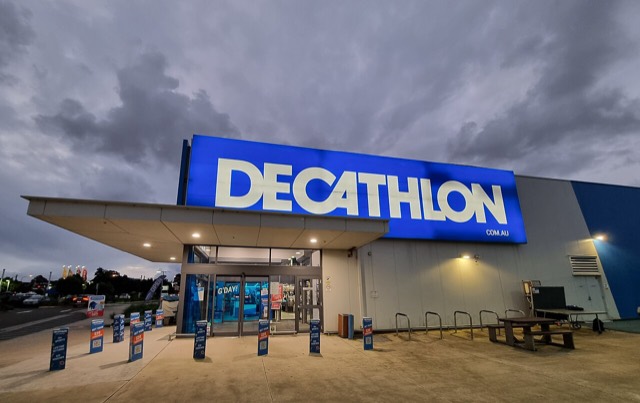
Maksym Kozlenko · CC BY-SA 4.0

Decathlon was founded in 1976 in Lille, France, by Michel Leclercq. It operates more than 1,700 stores across 70+ countries and designs, manufactures, and sells nearly all of its products under its own in-house brands, Quechua for hiking, Kipsta for team sports, Van Rysel for cycling, and so on. That vertical integration is the single biggest reason its prices are lower than most competitors: no middlemen, no licensing fees, no brand tax.

Despite its enormous global footprint, it is, by revenue, the world’s biggest sporting goods retailer ahead of Nike’s own retail and Sports Direct, Decathlon has a surprisingly low profile in the English-speaking world. It has a strong presence in India, the UK, most of Europe, and large parts of Asia, but the United States remains a conspicuous gap on its map.

The company is controlled by the Mulliez family, one of the most powerful and deliberately low-profile business dynasties in France. The Mulliez family association (AFM) also controls Auchan supermarkets, Leroy Merlin, and dozens of other major retail brands. They have operated for decades through a complex family holding structure specifically designed to avoid outside shareholders and media scrutiny.

Most people searching “Decathlon” are either loyal customers trying to justify a purchase, newcomers puzzled by its prices (cheap or expensive depending on their frame of reference), or Americans who have heard the name and wonder why they can’t find a store. A smaller share are looking up the athletic event, the ten-discipline track-and-field competition, which shares the same name.

People also ask

Relative to what? Decathlon is almost universally considered cheap by sporting goods standards, but if a product feels pricey to you, it's because Decathlon has been quietly moving upmarket. Its premium in-house lines, like Van Rysel road bikes or Simond climbing gear, now compete directly with specialist brands, and the prices reflect that positioning. You're no longer just buying a budget substitute; you're buying a product that costs real money to engineer.

Decathlon built its reputation on low prices, but its product range now spans entry-level to genuinely high-performance gear. The higher-end items carry higher prices because Decathlon invests heavily in its own R&D and materials, not because it's padding margins for a brand name. If something feels expensive at Decathlon, you're almost certainly looking at the top of their range, not the floor.

Decathlon's cycling sub-brands, Van Rysel, Rockrider, and Triban, have grown into serious competitors against Trek, Canyon, and Specialized. A high-spec carbon road bike or a full-suspension mountain bike requires expensive components regardless of who makes it, and Decathlon no longer hides from that reality. The honest answer is that good bicycles are just expensive, and Decathlon's higher-end cycles still typically undercut equivalent rivals by 20–30%.

Decathlon is owned and controlled by the Mulliez family through their family holding association, the Association Familiale Mulliez (AFM). The AFM is one of the largest and most secretive retail empires in Europe, also controlling Auchan, Leroy Merlin, and Boulanger, among others. There are no outside shareholders and no public listing, the family has structured ownership specifically to keep it that way.

Decathlon India is a wholly owned subsidiary of Decathlon S.A., the French parent company, which is in turn controlled by the Mulliez family. Decathlon entered India in 2009 and has grown to over 100 stores, making it one of the brand's most important growth markets. There is no separate Indian ownership stake, the Mulliez family structure runs straight through.

Decathlon UK operates as a subsidiary of Decathlon S.A., the French parent, controlled by the Mulliez family. It is not a franchise, a joint venture, or a separately listed entity. The UK business follows the same ownership model as every other Decathlon market, fully consolidated under the family holding structure based in Villeneuve-d'Ascq, France.

Decathlon is owned by the Mulliez family of France via their Association Familiale Mulliez (AFM), a private holding structure. Michel Leclercq, the founder, was himself a member of the Mulliez family by marriage. The company has never gone public and the family has consistently rejected outside investment, making it one of the most valuable privately held retail groups in the world.

The most famous real-world example is the Olympic decathlon, a two-day track-and-field competition for men. The current world record holder is Kevin Mayer of France, who scored 9,126 points in 2018. Historically, the event's most iconic champion is arguably Bruce Jenner (now Caitlyn Jenner), who won gold at the 1976 Montreal Olympics and was widely called "the world's greatest athlete" at the time.

Decathlon cuts out the supply chain layers that inflate everyone else's prices. It designs, manufactures, and sells its own products under its own brands, meaning there's no wholesaler markup, no licensing fee, and no celebrity endorsement budget to recover. Add massive economies of scale from being the world's largest sporting goods retailer, and cheap becomes the default, not a discount.

Decathlon is famous because it made sport accessible to people who couldn't afford Nike or Adidas prices, and it did it at scale across dozens of countries. In markets like France, India, Spain, and China, it's essentially the default answer to "where do I buy sports gear?" Its reputation for reliable, no-nonsense products at fair prices built genuine word-of-mouth loyalty that advertising money can't easily replicate.

People use "decathlon" both to refer to the athletic event and to the retail brand, and the overlap causes constant search confusion. The word itself comes from Greek, deca (ten) and athlon (contest). The French retail brand adopted the name in 1976 as a nod to sporting completeness and versatility, which is why both meanings collide in search results daily.

It isn't. Decathlon sells gear for women, men, and children across all its product categories, and has done so for decades. This question likely stems from confusion with the Olympic decathlon athletic event, which has historically been a men's-only competition, the women's equivalent is the heptathlon (seven events). The retail store has no gender restriction whatsoever.

Decathlon actually tried the US market, it opened stores in the San Francisco Bay Area starting in 2019, but quietly shut them all down by 2022. The US sporting goods market is brutally competitive, dominated by category killers like REI, Bass Pro, and Dick's Sporting Goods, plus direct-to-consumer giants like Nike and Patagonia. Decathlon's value proposition is compelling in markets with weaker local competition, but in the US, it couldn't build the footprint fast enough to compete.

A decathlon is a combined track-and-field competition consisting of ten events held over two days. Athletes accumulate points across all ten disciplines, and the highest total score wins. It is widely considered the ultimate test of all-around athletic ability, which is why its winner is traditionally nicknamed "the world's greatest athlete." Separately, Decathlon is also the name of the world's largest sporting goods retail chain, founded in France in 1976.

The ten events are split across two days. Day one: 100m sprint, long jump, shot put, high jump, 400m. Day two: 110m hurdles, discus throw, pole vault, javelin throw, 1500m. Points are awarded in each event using a standardized scoring table, and the athlete with the highest cumulative total wins.

No, not anymore. Decathlon opened several physical stores in California between 2019 and 2021 but exited the US market by 2022. As of now, there are no Decathlon retail stores operating in the United States. The brand does, however, maintain a US-facing website that ships internationally, so Americans can still order online.

For the athletic event, it stands for ten competitions, from the Greek deca (ten) and athlon (contest). For the French retailer, the founders chose the name as a metaphor for sporting completeness: a brand that covers every sport, the way a decathlete masters every discipline. It was a bold name for a shop in 1976 and, in hindsight, an accurate one.

Decathlon's US failure came down to timing, scale, and local competition. It entered with a handful of stores in the expensive San Francisco Bay Area, not nearly enough density to build brand recognition or supply chain efficiency. American consumers already had deeply entrenched alternatives, and Decathlon's private-label brands were unknown quantities in a market where brand identity drives purchasing decisions hard. Without the capital commitment to open 50–100 stores simultaneously, the formula simply didn't work.

The closest equivalent is Dick's Sporting Goods, a large-format sporting goods chain with broad category coverage. But the comparison has real limits: Dick's sells established third-party brands at full retail, while Decathlon's model is built on its own private labels at lower prices. REI is a closer cultural match for the outdoor segment, and Target or Walmart fill the budget tier. No single US retailer truly replicates what Decathlon does.

Yes, Decathlon ships to the US through its international e-commerce platform. Selection may be more limited than what's available in-store in other markets, and shipping costs plus import logistics mean you lose some of the price advantage that makes Decathlon compelling in the first place. For big or heavy items like bikes, buying from a US retailer will almost always be more practical.

Related topics
Culture Trending now
Taylor Swift and Travis Kelce Wedding 2026
Culture Trending now
Why Labubu is suddenly everywhere
Culture Trending now
The Odyssey (Christopher Nolan)
Culture Trending now
KPop Demon Hunters
Culture Trending now
House of the Dragon Season 3
Culture People
Adam Curry
Culture People
Adam Sandler
Culture People
Andrew Huberman