← BRANDS
datastats / Sport
LIVE
Sport

Asics

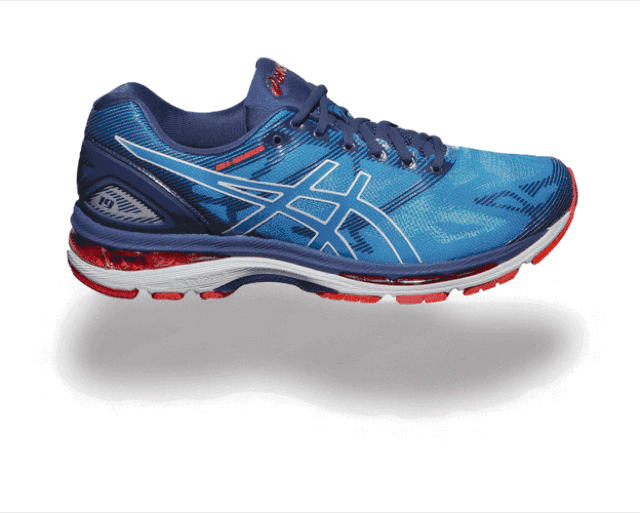
ASICS is a Japanese running powerhouse with a cult following among serious athletes, and a pricing strategy that won't apologize for it.
By · datastats · Updated June 4, 2026
Asics
Karldmartini · CC BY-SA 4.0

ASICS, full name Asics Corporation, is a Japanese athletic footwear and apparel company headquartered in Kobe, Japan. Founded in 1949 by Kihachiro Onitsuka, the brand spent decades as a niche darling of serious runners before exploding into mainstream fashion consciousness in the late 2010s and early 2020s, with retro silhouettes like the Gel-Kayano and Gel-Lyte III landing on the feet of everyone from marathon elites to streetwear enthusiasts.

What separates ASICS from a lot of its competitors is an almost stubborn commitment to performance engineering. The brand runs its own biomechanics research institute in Kobe, and its GEL cushioning technology, patented and refined over decades, remains one of the most respected shock-absorption systems in running. That research-first identity is both its greatest strength and the reason its premium shoes cost as much as they do.

People search for ASICS constantly because the brand straddles two very different worlds: hardcore running performance and retro sneaker culture. That tension raises real questions, is this a technical tool or a lifestyle flex? Is it worth the price? Is it better than Hoka, Nike, or Adidas? And increasingly, people are asking harder questions the brand’s marketing team definitely won’t bring up: boycotts, ownership, and whether it’s actually cheaper to buy in Japan.

The honest answers aren’t always flattering, and they’re not always what the brand would want front and center. That’s exactly why they’re worth reading.

People also ask

ASICS spends heavily on proprietary technology, its GEL cushioning, FlyteFoam midsoles, and GUIDESOLE geometry are all developed at the brand's own Institute of Sport Science in Kobe, and that R&D cost lands on the price tag. Premium models also use high-grade materials like engineered mesh uppers and carbon-fiber plates that genuinely cost more to produce. You're not just paying for a swoosh; you're paying for decades of biomechanical research, whether you actually need all of it or not.

ASICS shoes are expensive because the company treats footwear engineering as a science project, not just a branding exercise. High-performance lines like the Metaspeed Sky and Gel-Kayano are packed with proprietary materials and construction techniques that have real manufacturing costs. On top of that, the brand's retro lifestyle models have soared in cultural cachet, and when demand spikes, prices follow, especially in the resale market.

The core reason is that ASICS positions itself as a performance-first brand, and performance costs money. Its Institute of Sport Science, one of the few manufacturer-owned biomechanics labs in the world, continuously feeds new tech into its product lines, and that overhead doesn't come free. Add global distribution, premium retail partnerships, and growing brand heat from the fashion world, and you've got a company with every structural reason to keep prices high.

ASICS Corporation is a publicly traded Japanese company listed on the Tokyo Stock Exchange (ticker: 7936). There is no single controlling parent corporation, it is independently operated, with institutional and retail shareholders owning its stock. The founding Onitsuka family no longer controls the company; it has been a fully independent public entity for decades.

ASICS Corporation owns the ASICS brand and all its footwear lines. It also owns the Onitsuka Tiger brand, which operates as a separate, fashion-forward label while sharing the same corporate parent. No outside conglomerate, not Nike Inc., not Adidas AG, not LVMH, has ownership of ASICS. It is one of the few major athletic brands that remains independently publicly traded.

Sort of, it depends which list you mean. ASICS has not been a headline target of the major consumer boycott campaigns that hit Nike, H&M, and Adidas in 2021 over Xinjiang cotton sourcing, but that doesn't mean it's been fully cleared. NGO watchdogs and supply chain transparency organizations have flagged the broader sportswear industry, and ASICS has faced scrutiny over the opacity of its supply chain. The brand publishes sustainability reports, but independent auditors and advocacy groups have consistently noted that full transparency remains elusive across the industry. If you are consulting a specific boycott list for a specific cause, check that source directly, ASICS' status varies by campaign and by year.

Yes, for most popular models, buying ASICS in Japan is meaningfully cheaper than buying in the US or Europe, often 15–30% less before you factor in the consumption tax refund (8% back for tourists on purchases over ¥5,000). Japan also stocks colorways, limited editions, and Onitsuka Tiger collaborations that never make it to Western markets. If you're visiting Japan and you wear ASICS, bringing a spare suitcase is not a ridiculous idea.

If ASICS are hurting your feet, the most likely culprit is the wrong model for your foot type, ASICS builds shoes for specific gait profiles (neutral, overpronation, underpronation), and wearing the wrong category is a fast track to pain. It could also be sizing: ASICS tend to run slightly narrow in the toe box, which punishes wider feet. Break-in period, worn-out cushioning in older pairs, and simply choosing a shoe built for road running when you need trail support are all common issues worth ruling out.

ASICS is Japanese, full stop. It was founded in Kobe, Japan in 1949 by Kihachiro Onitsuka under the name Onitsuka Co., Ltd., and remains headquartered in Kobe today. It has large operations, distribution centers, and offices in the US and Europe, but its corporate identity, R&D headquarters, and founding roots are entirely Japanese.

For maximalist cushioning and ultra-distance running, Hoka has a genuine edge, its thick, rocker-shaped midsoles are purpose-built for reducing fatigue over long miles, and the brand has become the dominant force in trail ultras and everyday comfort walking. ASICS, however, wins on variety: it covers a broader spectrum of running disciplines, offers more precise fit options for performance runners, and its carbon-plated racers like the Metaspeed Sky are elite-level competitors. The honest answer is neither is universally better, Hoka for comfort and ultra-running, ASICS for structured performance and racing.

No, ASICS is not a luxury brand in the traditional sense. It does not operate in the luxury segment the way brands like Loro Piana or even premium-tier collaborations from Nike do. Its prices are high-performance-tier, not luxury-tier, and the brand has never positioned itself around exclusivity, heritage craftsmanship, or status signaling in the way luxury houses do. Onitsuka Tiger, its sister brand, flirts closer to luxury fashion, but ASICS proper is a performance sportswear brand with aspirational pricing.

No. ASICS is a completely independent company with zero ownership connection to Nike, Inc. They are direct competitors in the athletic footwear market. ASICS is a publicly traded Japanese corporation; Nike is a publicly traded American corporation. They share shelf space in running stores, not a balance sheet.

For elite competitive running and carbon-plate racing shoes, the two brands trade blows at the very top, Nike's Vaporfly and Alphafly are the most decorated marathon shoes in history, while ASICS' Metaspeed Sky has racked up its own podium finishes. For everyday training, injury prevention, and structural support, ASICS consistently earns higher marks from physical therapists and running-specialty retailers. Nike wins on cultural dominance, marketing, and lifestyle appeal. ASICS wins when the actual running matters more than the branding.

Nike is the world's best-selling footwear brand by a wide margin, with annual revenues exceeding $50 billion globally as of recent fiscal years. Adidas holds the #2 spot. ASICS sits further down the global rankings by revenue but commands a disproportionately large share of the serious running and specialty retail market, where brand loyalty runs deep among performance-focused consumers.

Adidas has a broader lifestyle and fashion footprint, a massive basketball and soccer presence, and the cultural clout of collaborations like Yeezy and Stan Smith. ASICS has more credibility in pure running performance, deeper gait-specific engineering, and a more loyal following among competitive runners. For everyday sneaker use and brand versatility, Adidas is the bigger tent. For running specifically, ASICS has the stronger technical case.

There is no single #1, it genuinely depends on use case, but the Nike Vaporfly series and the Adidas Adizero Adios Pro have dominated competitive marathon racing for most of the carbon-plate era. For daily training, ASICS' Gel-Kayano and Gel-Nimbus lines consistently rank at or near the top of running-specialty retailer charts. Hoka's Clifton and Bondi lines lead in comfort-focused running. The question of #1 is really the wrong question; the right question is #1 for what.

Cheaper in Japan, and it's not close for most models. Japanese retail prices are set lower to begin with, and international tourists can claim an 8–10% consumption tax refund at the point of purchase, widening the gap further. A shoe retailing for $160 in the US can regularly be found for the equivalent of $110–$130 in Japan after the tax refund. Limited and Japan-exclusive models add an extra layer of value for the dedicated shopper.

For running, yes, ASICS has deeper, more specialized running technology and a more extensive range of performance fits than Adidas. For everything else, soccer, basketball, lifestyle, fashion, cultural relevance, Adidas has the broader and stronger product portfolio. ASICS is a specialist; Adidas is a generalist. If your question is specifically about running shoes, ASICS wins. If the question is about brand breadth and lifestyle versatility, Adidas wins.

ASICS is an acronym for the Latin phrase *Anima Sana In Corpore Sano*, which translates to "A Sound Mind in a Sound Body", a phrase derived from the Roman poet Juvenal's famous line *mens sana in corpore sano*. Founder Kihachiro Onitsuka chose it to reflect his philosophy that sport builds mental and physical health together. It's one of the more meaningful brand acronyms in sportswear, and it's 100% intentional, not a retroactive marketing spin.

Yes, ASICS is one of the brands most consistently recommended by podiatrists and sports medicine professionals, particularly the Gel-Kayano, Gel-Nimbus, and GT series for runners with overpronation or a need for structured support. The brand's breadth of widths, gait-specific categories, and deep heel cushioning make it easier to match patients to appropriate footwear. That said, no single brand is universally right for every foot, and a good podiatrist will recommend based on your specific biomechanics, not brand loyalty.

Related topics
Sport Trending now
Argentina vs Spain: 2026 World Cup Final Preview
Sport Trending now
2026 NBA Finals
Sport Trending now
England vs Argentina 2026 World Cup Semi-Final
Sport Trending now
2026 World Cup Final: Date, Time, Venue and How to Watch
Sport Trending now
France vs Spain World Cup 2026 Semi-Final
Sport People
Aaron Judge
Sport People
Alexander Zverev
Sport People
Andre Agassi