← PEOPLE
datastats / Tech
LIVE
Tech

Satya Nadella

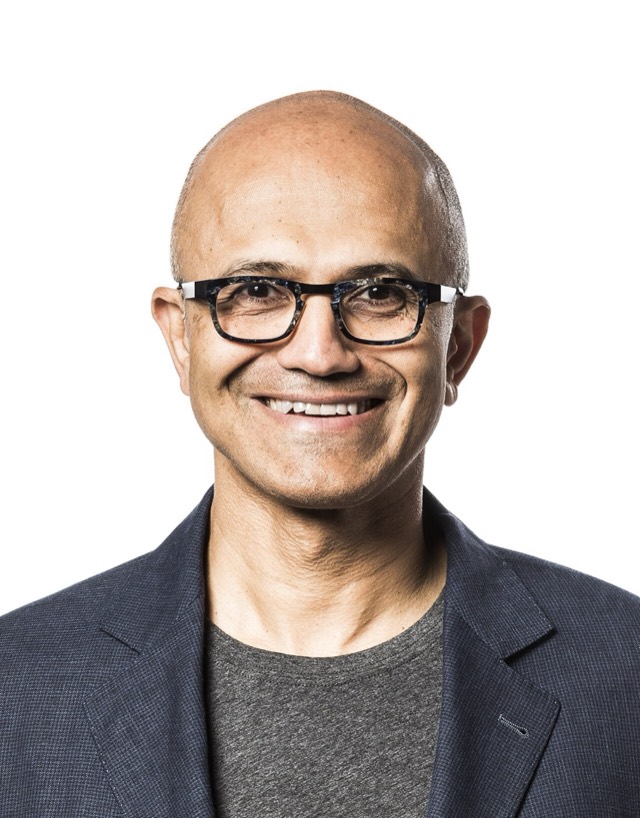
Satya Nadella turned Microsoft from a stagnating software giant into the world's most valuable AI-cloud company, and in 2026, he's doubling down on "agentic AI" to make sure it stays that way.
By · datastats · Updated June 15, 2026
Satya Nadella

Satya Nadella was born on 19 August 1967 in Hyderabad, India. He earned a master’s degree from the University of Wisconsin–Milwaukee and an MBA from the University of Chicago Booth School of Business before joining Microsoft in 1992, where he would spend his entire corporate career.

He became CEO of Microsoft in February 2014, taking over from Steve Ballmer, and added the Chairman title in 2021. Before the top job, he ran the Azure cloud division, which gave him a sharper strategic lens than almost anyone else in the building. That background turned out to matter enormously.

Nadella’s decade in charge has been defined by one relentless bet: the cloud and, now, AI. Azure became a genuine rival to AWS, the OpenAI partnership put Microsoft at the center of the generative-AI wave, and the company’s market capitalization soared into the multi-trillion-dollar range. At Build 2026, Nadella was pushing the next chapter, an “agent-first” strategy that embeds autonomous AI agents across every Microsoft product.

The scrutiny that comes with that scale is real. The U.S. Federal Trade Commission has opened an antitrust investigation into Microsoft’s Azure licensing practices, the bundling of Copilot into Microsoft 365, and the OpenAI partnership. It is an investigation, not a finding of wrongdoing, standard regulatory territory for any company this dominant.

People search for Nadella in 2026 because he is, arguably, the most consequential technology executive alive: the man steering the AI arms race from the cockpit of the world’s most valuable company.

People also ask

Nadella lives in the greater Seattle, Washington area, specifically the Eastside suburbs near Microsoft's Redmond campus, where he has been based for decades. No precise address is publicly confirmed, and we don't report private residential details.

Nadella holds American citizenship; he was born in India and is of Indian origin. He immigrated to the United States for graduate studies and built his entire career there.

Nadella was born on 19 August 1967, making him 57 years old as of mid-2026. He turns 58 in August 2026.

Nadella's height is not officially documented by Microsoft or any reliable source. Widely circulated estimates put him at around 6 feet (183 cm), but treat that as an informal observation, not a confirmed figure.

No audited, publicly verified figure exists for Nadella's net worth. Estimates from outlets like Forbes and Bloomberg fluctuate significantly with Microsoft's share price and his compensation package, which includes salary, bonuses, and stock awards. Citing any specific dollar amount as fact would be misleading, the honest answer is: very substantial, unconfirmed in precise terms.

Based on widely reported estimates, Nadella is generally assessed to be wealthier than Sundar Pichai, largely because Microsoft's stock performance under his tenure has been exceptional and his equity stake accumulated over more than three decades at the company. Both figures are estimates tied to fluctuating stock prices, so treat any specific comparison as approximate rather than definitive.

Nadella is married to Anupama Nadella (née Priyadarshini). They met as children in Hyderabad and married in 1992. Anupama is known for her advocacy work, particularly around issues related to disability, following the birth of their late son Zain, who had cerebral palsy.

He is married to Anupama Nadella. They have been married since 1992, making theirs one of the longer-standing marriages in the tech-CEO world, a detail Nadella has spoken about publicly in interviews.

Nadella's total compensation is disclosed in Microsoft's annual proxy filings. In recent fiscal years his total pay package, base salary plus cash bonus plus stock awards, has been reported in the range of roughly $50–80 million annually, with stock awards making up the overwhelming bulk. The exact figure shifts year to year; check Microsoft's latest proxy statement on SEC.gov for the most current number.

The most cited reason is his ability to change Microsoft's culture without blowing it up. He replaced an internal competition-obsessed "stack ranking" mindset with a "growth mindset" philosophy borrowed from Carol Dweck, which made teams collaborate rather than sabotage each other. He then made the right macro bets, cloud first, then AI, before Wall Street fully understood the opportunity, and he had the technical credibility to execute rather than just evangelize.

Nadella was chosen in 2014 because he had spent over two decades inside Microsoft, had already turned Azure into a credible business, and understood the cloud transition better than any other internal candidate. The board wanted an insider who could execute a cultural and strategic pivot, not a celebrity hire. He proved the pick right almost immediately.

The same answer as the net worth question: no audited number is public. Estimates vary widely based on Microsoft's stock price on any given day and are best described as "multi-billion dollar range" rather than any specific figure. Forbes and Bloomberg publish rolling estimates, but those are models, not balance sheets.

The CEO selection in 2014 was a board decision, not Gates's personal pick alone, Gates was not even executive chairman at the time. That said, Gates publicly endorsed Nadella and was involved in the process. The choice came down to Nadella's deep technical roots, his proven Azure track record, and the fact that he wasn't carrying the political baggage of the Ballmer era. Gates has since described Nadella as the right person for the role.

Almost certainly yes, based on widely reported estimates of his accumulated Microsoft stock and compensation over three decades, but no independently audited figure confirms it officially. Forbes and Bloomberg estimate his wealth in the billions, but those figures move with Microsoft's share price and are not verified disclosures.

This is a widely repeated anecdote: Nadella has said in interviews that when his H-1B visa was expiring, he and his wife had to choose between staying in the U.S. or returning to India, and that his wife gave up her own green card process so they could remain together on his visa track. He eventually became a U.S. citizen. He has used this story to advocate for immigration reform. The detail that he personally "gave up" a green card is not the precise framing, it was a complex visa/timing situation, not a voluntary renunciation.

Nadella was raised Hindu in Hyderabad, and Hindu cultural influences are evident in references he makes publicly, including to the Bhagavad Gita. He has also described attending a Catholic school and absorbing diverse philosophical traditions. He does not publicly label himself with a strict religious identity, so characterizing him simply as "a Hindu" is broadly accurate as background but incomplete as a full description.

Nadella has not made any public statement declaring himself vegetarian or vegan, and no reliable reporting documents his diet in detail. This is a private matter he has not addressed publicly, so any specific claim about his eating habits would be speculation.

Yes. Nadella was among the prominent tech executives who attended Donald Trump's January 2025 inauguration, alongside figures like Elon Musk, Jeff Bezos, Mark Zuckerberg, and Sundar Pichai. The attendance was widely reported and photographed, reflecting the tech industry's visible outreach to the incoming administration.

They have a collegial professional relationship built over decades at Microsoft, and Gates has spoken warmly about Nadella in public. Whether they are close personal friends in the private sense is not something either has detailed extensively. "Mutual respect between a founder and a successor CEO" is the safest accurate description; "friends" in a deep personal sense is unconfirmed.

Nadella has mentioned in interviews that he prioritizes sleep and aims for around seven to eight hours a night, notably pushing back against the Silicon Valley "sleep is for the weak" cult. He has cited sleep as essential to sustained cognitive performance. The exact nightly figure is self-reported and anecdotal, not clinically verified.

Related topics
Tech Trending now
Claude Fable 5
Tech Trending now
ChatGPT
Tech Trending now
Gemini-Powered Siri
Tech Trending now
iOS 27
Tech Trending now
ChatGPT vs Claude
Tech People
Andy Jassy
Tech People
Bill Gates
Tech People
Dario Amodei