← BRANDS
datastats / Tech
LIVE
Tech

Nvidia

Nvidia went from a gaming-graphics company to the most valuable chipmaker on earth, because the AI boom runs on its hardware.
By · datastats · Updated June 13, 2026
Nvidia
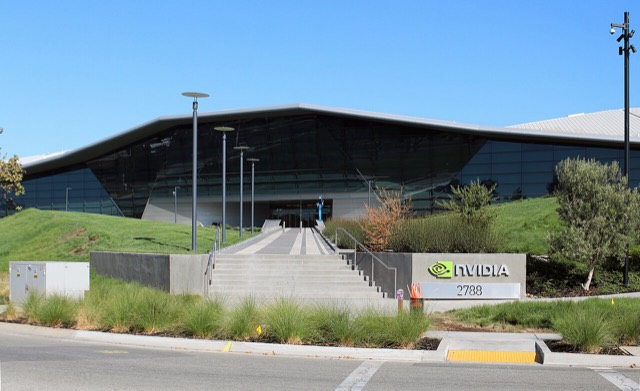
Coolcaesar · CC BY-SA 4.0

Nvidia was founded in 1993 by Jensen Huang, Chris Malachowsky and Curtis Priem to build better graphics chips for PCs and games. For its first two decades it was known mainly to gamers, through its GeForce line. The pivot that made it a household name was recognising that the same parallel-processing hardware used to render game worlds was ideal for training neural networks, and building the CUDA software platform that made GPUs programmable for general computing.

When the generative-AI boom arrived, Nvidia was the only company with the chips, the software and the supply relationships ready at scale. Its data-center revenue exploded, its market value crossed into the trillions, and it became a barometer for the entire AI economy. The questions below cover what people most want to understand: what it sells, why it’s worth so much, who runs it, and where the risks lie. None of this is financial advice, figures and rankings reflect widely reported information as of 2025–2026.

People also ask

Nvidia designs GPUs, graphics processing units, and the software that runs on them. It started in 1993 making chips that render video-game graphics, but its real fortune came from a second use: GPUs are exceptionally good at the parallel math that powers artificial intelligence. Today Nvidia sells the data-center chips (like the H100 and Blackwell series) that train and run almost every major AI model, alongside its consumer GeForce gaming cards and its CUDA software platform. It designs the chips; it doesn't manufacture them, that's done by TSMC in Taiwan.

Because the AI boom physically depends on its chips. Training large AI models requires enormous parallel computing power, and Nvidia's data-center GPUs have been the default, by a wide margin, for doing it. When companies like Microsoft, Google, Meta, Amazon and OpenAI spend tens of billions on AI infrastructure, a large share flows to Nvidia. That demand pushed its market value past $3 trillion, briefly making it one of the most valuable companies in the world. Whether that valuation is durable is exactly what investors argue about.

Nvidia is a publicly traded company (Nasdaq: NVDA), so it is owned by its shareholders. The largest holders are big institutional investors, index funds like Vanguard and BlackRock, rather than any single person. Co-founder and CEO Jensen Huang owns a meaningful personal stake (low single-digit percentage), which is large in dollar terms but far from control. There is no parent company; Nvidia owns itself in the corporate sense.

Jensen Huang is Nvidia's co-founder and CEO, in the role since he started the company in 1993, an unusually long tenure for a tech giant. Known for his black leather jacket and hands-on engineering reputation, he steered Nvidia's bet that GPUs would matter far beyond gaming, a bet that defined the AI era. He is now one of the wealthiest people in tech, almost entirely through his Nvidia stake.

That's a question only you and a financial adviser can answer, this isn't investment advice. What's factual: Nvidia has delivered extraordinary growth on the back of AI demand, but it also trades at a high valuation, which means a lot of future growth is already priced in. Risks that analysts regularly flag include a slowdown in AI spending, rising competition from AMD and from customers building their own chips, and its reliance on TSMC and on a few huge buyers. High reward has come with high volatility.

AI models are built from billions of simple calculations that can run at the same time, and GPUs are designed for exactly that kind of massively parallel work, unlike traditional CPUs, which do fewer things very fast in sequence. Nvidia's lead isn't only the hardware: its CUDA software platform, built up over more than 15 years, is what most AI researchers and frameworks are written for. That software 'moat' is a big reason rivals struggle to displace it even when their chips are competitive on paper.

Both design GPUs, but Nvidia dominates the AI data-center market while AMD has historically been stronger on price-competitive gaming and CPUs. AMD's data-center GPUs (the Instinct line) are a genuine challenger and are improving fast, but Nvidia's CUDA software ecosystem and its head start in AI give it a large lead in that specific, very lucrative segment. In consumer gaming cards, the two compete much more directly on performance and price.

It isn't a legal monopoly, but it holds a dominant position, by most estimates well over 80%, in the AI data-center GPU market, which has drawn regulatory attention in the US, EU and China. Dominance isn't illegal on its own; the scrutiny focuses on whether Nvidia uses practices like bundling or supply allocation to lock in that lead. Competition exists (AMD, plus in-house chips from Google, Amazon and others), but for now Nvidia's combination of hardware and CUDA software keeps it far ahead.

Nvidia is a 'fabless' company: it designs the chips but outsources manufacturing, primarily to TSMC (Taiwan Semiconductor Manufacturing Company) in Taiwan, with advanced packaging and memory from partners like SK Hynix and others. This is why Nvidia's supply, and the broader AI industry, is so sensitive to TSMC's capacity and to geopolitical tension around Taiwan.

Related topics
Tech Trending now
Claude Fable 5
Tech Trending now
ChatGPT
Tech Trending now
Gemini-Powered Siri
Tech Trending now
iOS 27
Tech Trending now
ChatGPT vs Claude
Tech People
Andy Jassy
Tech People
Bill Gates
Tech People
Dario Amodei